Amitava Das
Professor, BITS Goa | Former Research Associate Professor, AIISC, USA
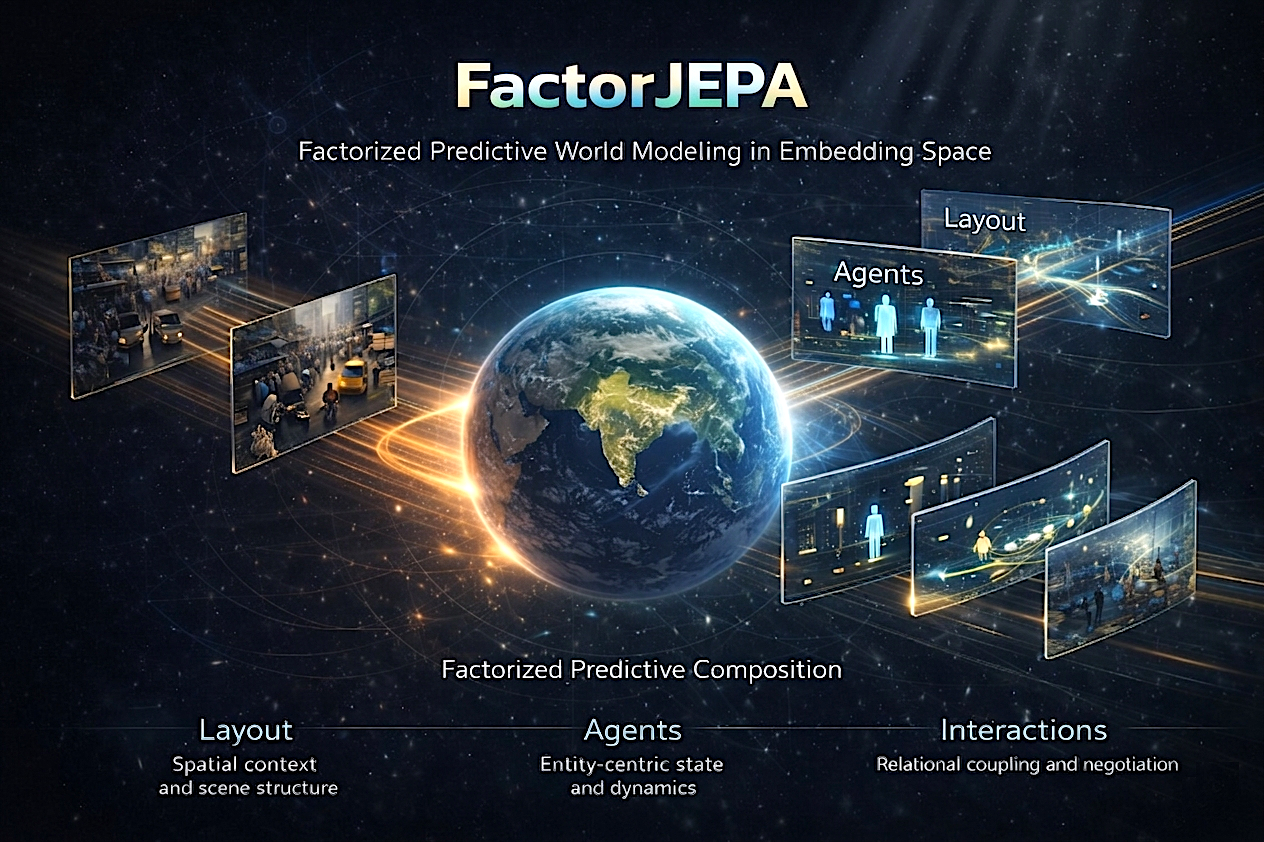
Validation on Kolkata Traffic Dataset
Optimized for Edge-TPU Deployment
Scalable Spatial Embeddings
Cumulative A100 Compute Hours

Scenario: Dense Urban Occlusion

Scenario: Multi-Agent Interactions

Scenario: Narrow-Path Navigation
Predictive embeddings remain stable in traffic scenes where most objects are partially hidden.
Factorized state-space modeling improves multi-agent motion forecasting under chaotic urban conditions.
The model discovers feasible paths through constrained alleys with fine-grained semantic understanding.
Long-range latent predictions remain stable under heavy visual clutter, extending useful forecasting windows for planning.
Factorized latent decomposition sustains accuracy in high-density scenes without exponential compute growth.
Professor, BITS Goa | Former Research Associate Professor, AIISC, USA

GenAI Leadership @ AWS | Stanford AI | Ex-Amazon Alexa, Nvidia, Qualcomm | EB-1 "Einstein Visa" Recipient | EMNLP 2023 Outstanding Paper Award

Applied Research Scientist Lead at Facebook AI Research | 6k+ citations | Ex-Citadel | CMU | IIT Kanpur | Startup Advisor & Mentor | Angel Investor | EB1A green card recipient
AI @ Meta | Ex-Amazon, Oracle, PANW | Stanford AI | EMNLP Outstanding Paper Award Recipient