

 Lens - Neural Cultural Conflict Loss (nCCL): Quantifying Ideological Misalignment in Cross-Cultural Foundation Models
As artificial intelligence increasingly permeates global society, foundation models trained or fine-tuned on culturally diverse datasets have become ubiquitous. The metrics we have introduced so far–nHD, nGDI, nTDS, nKaryotyping, nDIV, and nEPI–have significantly advanced our understanding of semantic divergence, representational dominance, inheritance directionality, and semantic adaptability in these models. However, these metrics predominantly capture the magnitude or direction of latent representational shifts, leaving the vital and nuanced phenomenon of semantic conflict–the nonlinear, ideologically charged tension arising between distinct cultural priors–largely unexplored.
Inspiration
To bridge this critical gap, we introduce the Neural Cultural Conflict Loss (nCCL), a mathematically rigorous metric designed to detect and quantify latent semantic conflicts arising when culturally distinct semantic manifolds are fused within foundation models. Unlike distance or dominance metrics that measure overall divergence or dominance strength, nCCL explicitly captures layerwise semantic tension manifesting as ideological dissonance in the latent space. This tension emerges due to nonlinear interactions–akin to genetic incompatibilities and epistasis in biological hybrids–where merging cultural priors results in representational fractures and semantic fractures rather than smooth blending.
Formally, nCCL operates within the Neural DNA (nDNA) geometric framework, leveraging the Fisher information metric to define a curvature-aware semantic interpolation between parent models. The metric quantifies the deviation of the merged model’s latent embeddings from this Fisher-weighted barycenter, thereby pinpointing ideological divergence hotspots concentrated in specific transformer layers. These conflict zones indicate where naive linear merging fails, and targeted layerwise interventions are necessary to restore semantic harmony.
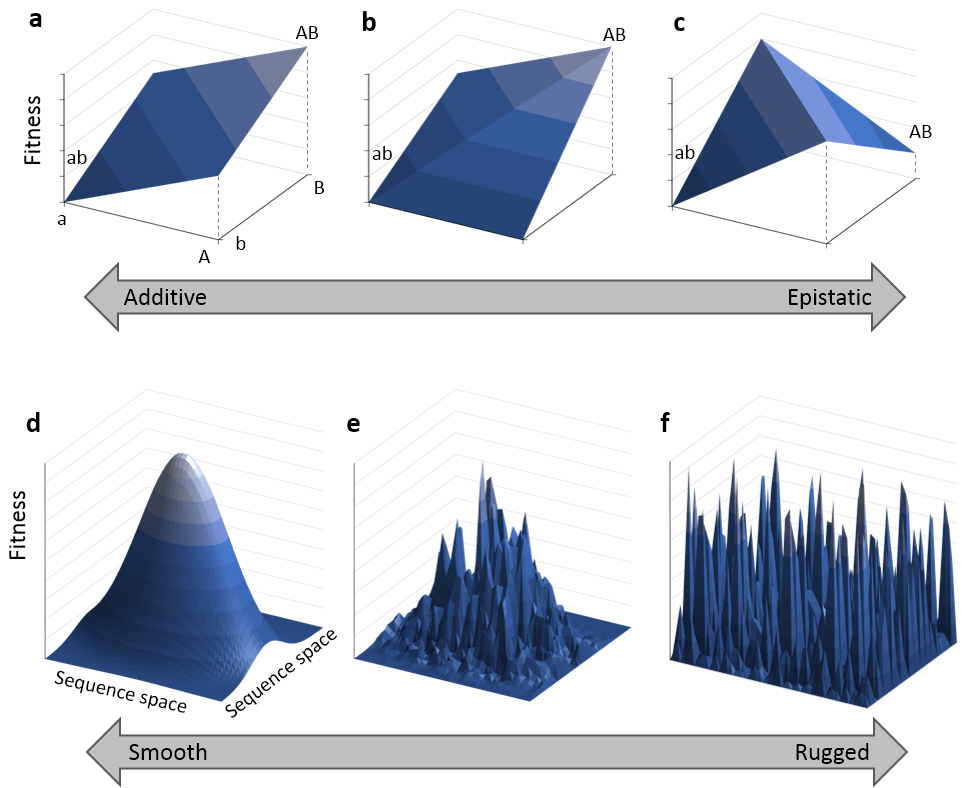
This paradigm is conceptually illustrated by biological fitness landscapes under epistatic gene interactions (see Figure below), where additive genetic contributions yield smooth phenotypic optima, but pervasive epistasis produces rugged, complex landscapes with multiple local optima and unpredictable outcomes. Analogously, cultural semantic priors combine nonlinearly in latent space, generating rugged semantic fitness landscapes that manifest as conflicts or fractures obstructing smooth fusion.
Understanding and quantifying these conflicts through nCCL is indispensable for the development of culturally coherent, inclusive, and robust AI systems. It enables principled semantic realignment, fine-tuning, and mitigation strategies, paralleling biological genetic rescue mechanisms that alleviate hybrid incompatibilities and restore vigor.
In summary, nCCL fills the vital role of a geometry-aware, nonlinear diagnostic of ideological misalignment in foundation models, complementing and extending existing metrics by elucidating where and why cultural semantic priors clash within merged representations. This insight provides a principled foundation for designing targeted, layer-specific alignment interventions critical for trustworthy and fair AI in diverse global contexts.
Mathematical Formulation
The Neural Cultural Conflict Loss (nCCL) quantifies the latent semantic tension arising from merging or jointly deploying foundation models pretrained or fine-tuned on culturally distinct data. This is formalized within the Neural DNA (nDNA) geometric framework, where each model $M_A$ and $M_B$ is characterized by its layerwise latent semantic trajectory:
\[\mathbf{x}^{(A)}_\ell, \quad \mathbf{x}^{(B)}_\ell \in \mathbb{R}^d, \quad \ell = 1, \ldots, L,\]where $L$ denotes the total number of transformer layers, and $d$ is the embedding dimension. These trajectories capture high-dimensional semantic manifolds encoding distinct cultural priors.
When merging these models, the combined or offspring model is represented by latent embeddings $\mathbf{x}^{(\mathrm{merged})}_\ell$. Unlike naive averaging, the merging operation incorporates representational fidelity via the Fisher information metric([1];[2]), ensuring geometrically meaningful interpolation:
\[\mathbf{x}^{(\mathrm{merged})}_\ell \approx \Phi\big(\mathbf{x}^{(A)}_\ell, \mathbf{x}^{(B)}_\ell\big) := \big( \mathbf{F}_\ell^{(A)} + \mathbf{F}_\ell^{(B)} \big)^{-1} \big( \mathbf{F}_\ell^{(A)} \mathbf{x}^{(A)}_\ell + \mathbf{F}_\ell^{(B)} \mathbf{x}^{(B)}_\ell \big),\]where \( \mathbf{F}_\ell^{(A)} \) and \( \mathbf{F}_\ell^{(B)} \) are the Fisher information matrices of models \( A \) and \( B \) at layer \( \ell \), encoding local curvature and uncertainty in the latent space.
The Neural Cultural Conflict Loss at layer $\ell$ measures the normalized discrepancy between the actual merged embedding and its idealized Fisher-weighted interpolation:
\[\mathrm{nCCL}_\ell := \frac{\left\| \mathbf{x}^{(\mathrm{merged})}_\ell - \Phi\big(\mathbf{x}^{(A)}_\ell, \mathbf{x}^{(B)}_\ell\big) \right\|_2}{\frac{1}{2} \big( \|\mathbf{x}^{(A)}_\ell\|_2 + \|\mathbf{x}^{(B)}_\ell\|_2 \big) + \epsilon},\]with $\epsilon > 0$ ensuring numerical stability.
The global conflict metric aggregates this layerwise loss across the model depth:
\[\mathrm{nCCL} := \frac{1}{L} \sum_{\ell=1}^L \mathrm{nCCL}_\ell,\]capturing the overall degree of latent ideological divergence induced by merging cultural priors.
Detailed Derivation
The Fisher information matrix $\mathbf{F}_\ell^{(M)}$ for model $M$ at layer $\ell$ is given by the expected outer product of the gradient of the log-likelihood:
\[\mathbf{F}_\ell^{(M)} := \mathbb{E}_{x \sim \mathcal{D}^{(M)}} \left[ \nabla_{\mathbf{x}_\ell} \log p_M(y \mid x) \nabla_{\mathbf{x}_\ell} \log p_M(y \mid x)^\top \right],\]where $\mathcal{D}^{(M)}$ is the data distribution reflecting the cultural corpus for model $M$.
This matrix captures the local curvature of the semantic manifold at layer $\ell$, providing a natural Riemannian metric for measuring distances and interpolations in latent space([1];[9]).
By leveraging this metric, the merging function $\Phi$ ensures that embeddings are combined respecting local geometry and information content, rather than naive Euclidean averaging, which can distort semantic fidelity and exaggerate conflicts.
Geometric Interpretation
The nCCL quantifies the deviation of the actual merged representation from this Fisher-weighted barycenter. Large $\mathrm{nCCL}_\ell$ values indicate layers where semantic representations fail to reconcile cultural priors, manifesting as ideological tension zones in the latent geometry.
Analyzing $\mathrm{nCCL}_\ell$ across layers reveals conflict loci, providing precise targets for semantic realignment, fine-tuning, or mitigation to achieve cross-cultural coherence.
This formulation extends classical epistasis concepts from population genetics([10];[7]) to high-dimensional neural representations, framing cultural conflict as an incompatibility of latent gene-like semantic structures that must be harmonized for integrated global AI systems.
Interpretation and Implications
The Neural Cultural Conflict Loss (nCCL) encapsulates a profound measure of latent representational divergence that arises due to the fusion of culturally distinct semantic manifolds within large-scale foundation models. Formally, a large magnitude of
\[\text{nCCL}_\ell = \frac{\left\| \mathbf{x}^{(merged)}_{\ell} - \Phi(\mathbf{x}^{(A)}_{\ell}, \mathbf{x}^{(B)}_{\ell}) \right\|_2}{\frac{1}{2}(\|\mathbf{x}^{(A)}_{\ell}\|_2 + \|\mathbf{x}^{(B)}_{\ell}\|_2) + \epsilon}\]signifies the presence of significant semantic dissonance at layer $\ell$, implying that the merged latent trajectory $\mathbf{x}^{(merged)}_{\ell}$ cannot be faithfully approximated by the Fisher-weighted parent embeddings. This deviation quantifies the extent to which cultural priors conflict, generating non-linear interactions and latent tension akin to epistatic incompatibilities in hybrid biological genomes([10];[7]).
Such representational incongruities are not uniformly distributed across layers. Early transformer layers, which predominantly encode low-level lexical and syntactic features, tend to exhibit minimal semantic divergence \( \text{nCCL}_\ell \approx 0 \), consistent with shared foundational language constructs across cultures. In contrast, intermediate and deep layers encode high-level, abstract semantic and cultural concepts, where \( \text{nCCL}_\ell \) often peaks, revealing critical loci of ideological tension that jeopardize semantic coherence and model reliability.
Mathematically, this layerwise variation in nCCL reflects the hierarchical geometry of neural semantic manifolds, where curvature and topological complexity escalate with semantic abstraction. The Fisher metric weighting $\Phi$ inherently respects the information geometry of these manifolds, such that $\text{nCCL}_\ell$ exposes where merged embeddings depart from geodesic interpolations on the semantic manifold, signaling topological obstructions and semantic fractures that challenge smooth fusion.
This nuanced understanding informs a mathematically principled approach to alignment interventions: targeted layer-specific regularization, semantic disentanglement, and adaptive manifold smoothing are required to navigate and resolve these latent conflicts. Such interventions parallel genetic rescue in population genetics[8], where resolving epistatic incompatibilities restores hybrid vigor–similarly, resolving nCCL-driven tensions restores semantic harmony and alignment robustness in multicultural AI.
In sum, nCCL provides a rigorous, geometry-aware diagnostic to pinpoint where and why cultural semantic priors clash within merged foundation models. This enables the design of precise, theoretically grounded correction mechanisms, fostering the emergence of culturally coherent, trustworthy, and equitable AI systems capable of nuanced cross-cultural understanding and generation.
Applications and Empirical Insights
The Neural Cultural Conflict Loss (nCCL) offers a mathematically grounded lens to dissect and manage latent ideological divergences within culturally heterogeneous AI models. Leveraging its geometric and representational fidelity framework, nCCL enables a suite of applications critical for advancing cross-cultural AI alignment:
-Multilingual Alignment Audits: By decomposing the global \( \mathrm{nCCL} \) metric into layerwise components \( \mathrm{nCCL}_\ell \), practitioners gain granular visibility into semantic discord concentrated in specific transformer layers or embedding subspaces. Formally, layers \( \ell \) with elevated \( \mathrm{nCCL}_\ell \) indicate regions where
\[\left\| \mathbf{x}_\ell^{(\mathrm{merged})} - \Phi(\mathbf{x}_\ell^{(A)}, \mathbf{x}_\ell^{(B)}) \right\|_2\]exceeds a critical threshold, signaling latent ideological friction. This quantitative insight informs targeted fine-tuning protocols, such as adversarial or contrastive regularization on the embeddings $\mathbf{x}_\ell$, aimed at minimizing cultural semantic drift while preserving core knowledge.
-
Model Fusion Diagnostics: In the context of Fisher information weighted merging operators $\Phi$, nCCL functions as a proxy for semantic fidelity loss during fusion. By explicitly evaluating
\[\mathrm{nCCL}_\ell = \frac{\left\| \mathbf{x}_\ell^{(\mathrm{merged})} - \Phi(\mathbf{x}_\ell^{(A)}, \mathbf{x}_\ell^{(B)}) \right\|_2}{\frac{1}{2} \left( \|\mathbf{x}_\ell^{(A)}\|_2 + \|\mathbf{x}_\ell^{(B)}\|_2 \right) + \epsilon},\]developers can systematically quantify and minimize fusion-induced representational distortions, guiding the design of fusion mechanisms that balance diversity and alignment. This metric also aids in detecting emergent semantic conflicts caused by nonlinear interactions between culturally disparate priors.
-
Cross-Cultural Deployment Optimization: nCCL’s layerwise profiles enable strategic adaptation of foundation models for deployment in specific cultural contexts. By optimizing over layers with significant $\mathrm{nCCL}_\ell$, one can adjust embedding distributions or modify training objectives to reduce semantic tension, thereby improving cross-cultural robustness and interpretability. This formalism facilitates principled transfer learning and domain adaptation in multicultural environments, ensuring equitable model behavior and fairness metrics aligned with sociocultural expectations.
Through these mathematically principled applications, nCCL serves as a critical quantitative framework that operationalizes cross-cultural semantic alignment in foundation models, bridging theoretical insights with practical alignment engineering.
Case Study and Validation
To empirically validate the Neural Cultural Conflict Loss (nCCL), we analyze foundation models pretrained or fine-tuned on culturally distinct corpora, such as European and Asian linguistic datasets. By extracting layerwise latent embeddings \( \mathbf{x}_\ell^{(\text{Eur})} \), \( \mathbf{x}_\ell^{(\text{Asi})} \), and the merged offspring embeddings \( \mathbf{x}_\ell^{(\text{Merged})} \), we compute the \( \mathrm{nCCL}_\ell \) metric:
\[\mathrm{nCCL}_\ell = \frac{\left\| \mathbf{x}_\ell^{(Merged)} - \Phi\left(\mathbf{x}_\ell^{(Eur)}, \mathbf{x}_\ell^{(Asi)}\right) \right\|_2}{\frac{1}{2}\left( \|\mathbf{x}_\ell^{(Eur)}\|_2 + \|\mathbf{x}_\ell^{(Asi)}\|_2 \right) + \epsilon},\]where $\Phi$ is the Fisher-weighted merging operator encoding representational fidelity.
Layerwise visualization of $\mathrm{nCCL}_\ell$ reveals pronounced peaks in the intermediate-to-deep transformer layers $\ell \in [22,28]$, identifying ideological divergence hotspots that correspond to abstract semantic constructs rather than surface lexical differences. These conflict zones underscore the complexity of cross-cultural semantic fusion, highlighting that naive parameter averaging fails to reconcile deep cultural priors.
Furthermore, these empirical observations align with biological phenomena of epistatic interactions and genetic incompatibilities in hybrid genomes, where emergent phenotypes result from nonlinear gene interactions that cannot be explained by simple additive effects([10];[7]). Analogously, the layer-specific nCCL peaks suggest that cultural semantic misalignment is a deeply nonlinear phenomenon embedded within the latent representational geometry.
This detailed analysis enables targeted layer-specific fine-tuning or alignment correction interventions focused on the identified conflict layers, aiming to minimize $\mathrm{nCCL}_\ell$ while preserving semantic integrity and cultural fidelity. Such approaches promote robust, fair, and interpretable AI systems that are sensitive to cultural nuances, crucial for deployment in diverse global contexts.
Overall, the case study demonstrates the practical utility of nCCL as both a diagnostic and prescriptive tool for cross-cultural model integration, offering a principled pathway to navigate the intricate landscape of cultural semantic alignment.
Outlook
The Neural Cultural Conflict Loss (nCCL) establishes a critical and foundational framework within the emerging paradigm of Neural Genomics, specifically tailored for the detection, quantification, and resolution of latent ideological conflicts that naturally arise in cross-cultural AI systems. By providing fine-grained, layerwise insights into semantic tension across the depths of foundation models, nCCL enables practitioners and researchers to diagnose where and how conflicting cultural priors manifest within the latent representational geometry. This capacity for precise localization fosters culturally coherent, trustworthy, and robust AI architectures that honor and integrate diverse cultural perspectives without sacrificing semantic fidelity or ethical alignment.
Moreover, the nCCL framework opens new avenues for the design of sophisticated, targeted alignment interventions that operate at specific layers or semantic subspaces, moving beyond monolithic tuning approaches toward adaptive fine-tuning strategies. Such nuanced interventions can dynamically reconcile conflicting cultural semantic manifolds, mitigate bias propagation, and preserve the rich complexity of culturally embedded knowledge representations.
Looking forward, nCCL lays the groundwork for innovative research into continual learning and context-aware adaptation in multilingual and multicultural AI deployments. By systematically capturing and addressing ideological tension at multiple semantic scales, this framework supports the development of AI systems capable of ongoing evolution in response to shifting cultural contexts and emerging ethical standards. This positions nCCL not only as a diagnostic tool but as a catalyst for responsible, inclusive, and context-sensitive AI innovation on a global scale.
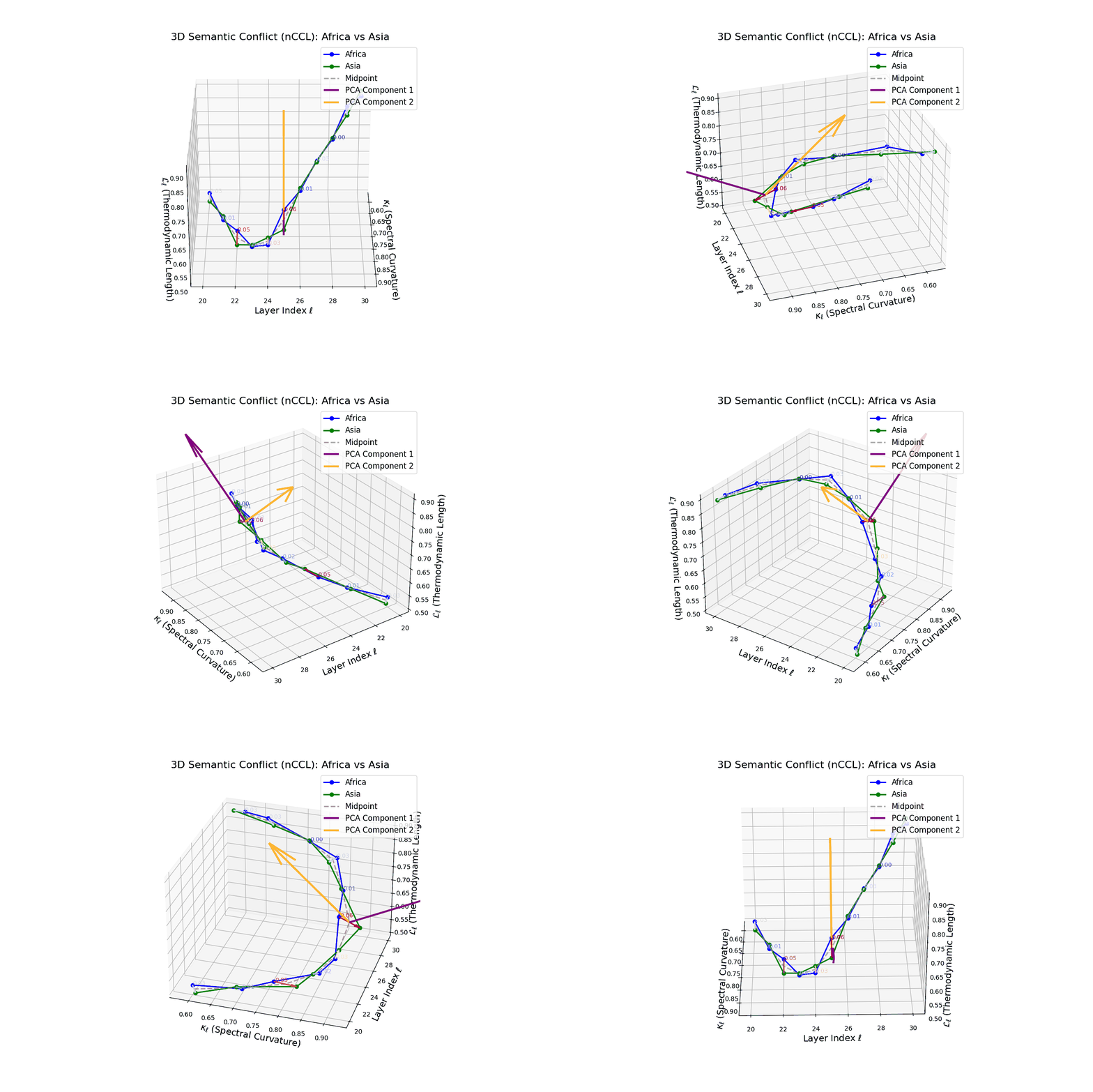
Let $x_\ell(\mathrm{Africa})$ and $x_\ell(\mathrm{Asia})$ denote latent semantic embeddings for parent models representing African and Asian cultural priors, with merged offspring embedding $x_\ell(\mathrm{Merged})$ at layer $\ell$. The conflict metric $\Delta_\ell = \left|x_\ell(\mathrm{Merged}) - \Phi \left(x_\ell(\mathrm{Africa}), x_\ell(\mathrm{Asia})\right)\right|$ is low in early layers $\ell \in [20, 21]$, showing stable inheritance and semantic alignment. Conflict rises in mid layers $\ell \in [22, 28]$, marking ideological tensions needing layerwise tuning and reconciliation. Conflict moderates late $\ell \in [29, 30]$, reflecting semantic fusion, emphasizing targeted alignment interventions.
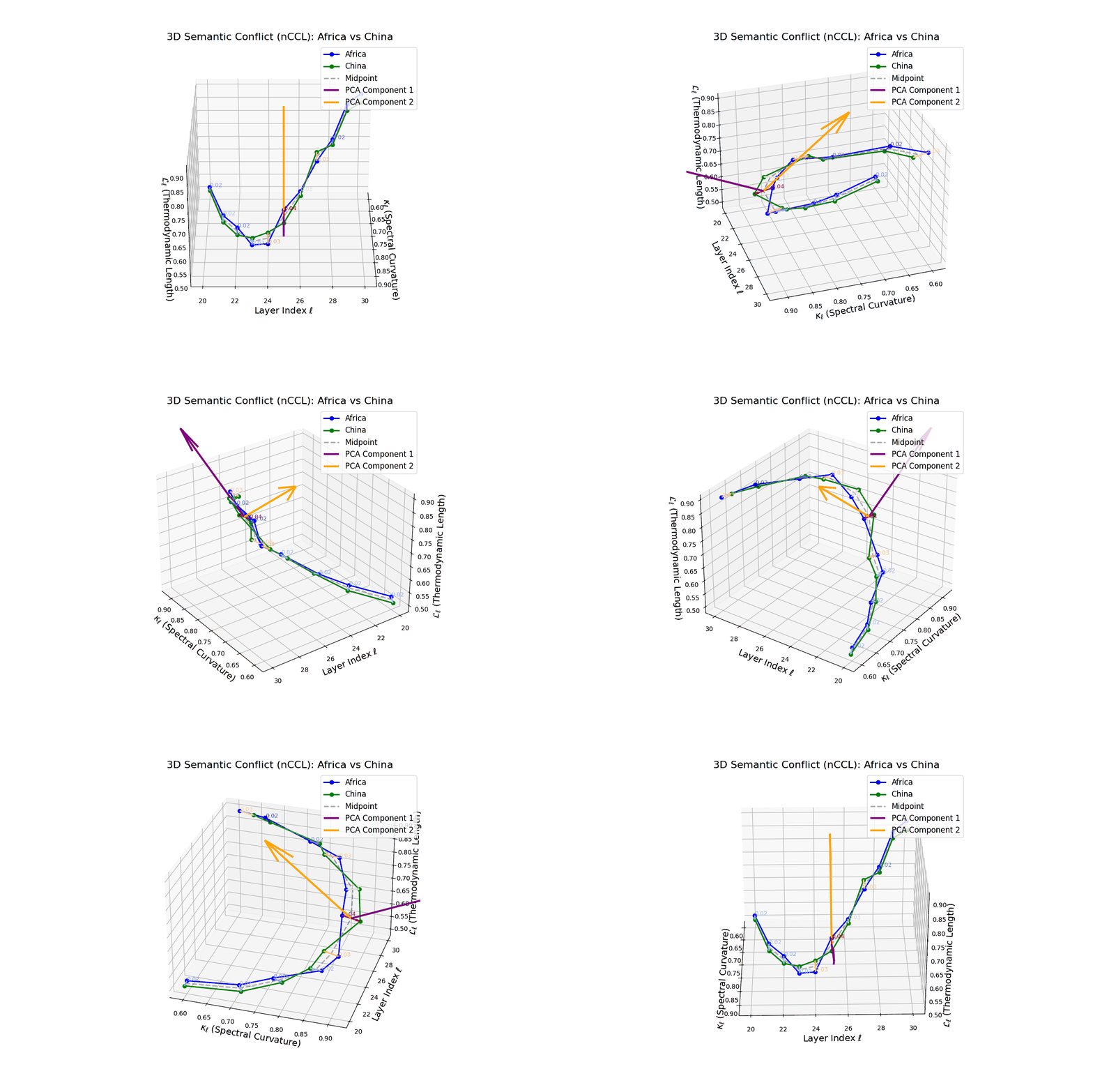
Let $x_\ell(\mathrm{Africa})$ and $x_\ell(\mathrm{China})$ denote latent embeddings for African and Chinese priors, and $x_\ell(\mathrm{Merged})$ the merged offspring embedding at layer $\ell$. The conflict $\Delta_\ell = \left|x_\ell(\mathrm{Merged}) - \Phi \left(x_\ell(\mathrm{Africa}), x_\ell(\mathrm{China})\right)\right|$ is minimal in early layers $\ell \in [20, 21]$, reflecting semantic consistency. Conflict intensifies in mid layers $\ell \in [23, 27]$, revealing ideological divergence requiring precise semantic harmonization. Late layers $\ell \in [28, 30]$ show reduced conflict, indicating semantic reconciliation vital for crosscultural robustness and emergent expressivity.
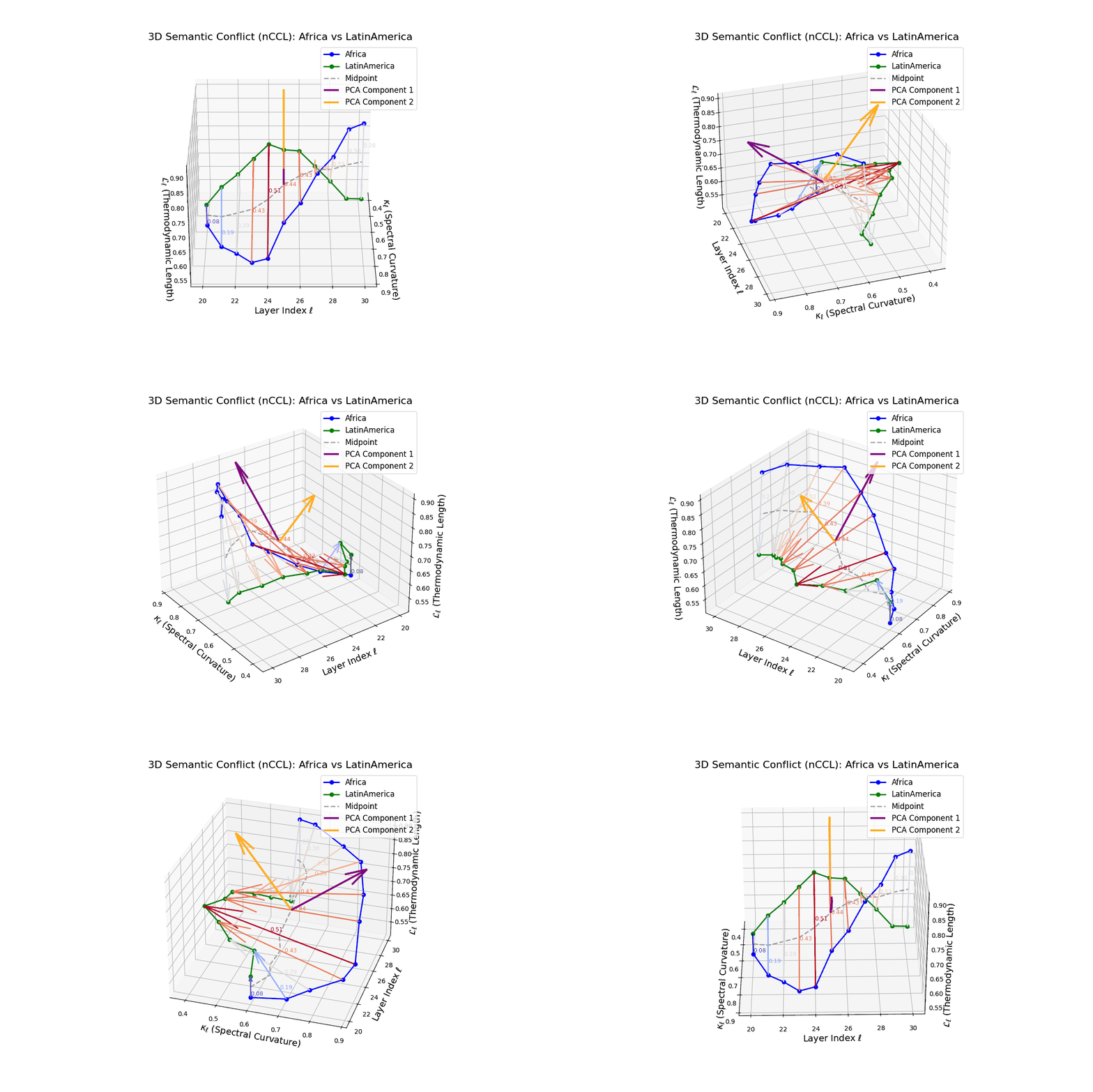
Let $x_\ell(\mathrm{Africa})$ and $x_\ell(\mathrm{LatinAmerica})$ denote latent embeddings, and $x_\ell(\mathrm{Merged})$ the merged offspring embedding at layer $\ell$. The conflict $\Delta_\ell = \left|x_\ell(\mathrm{Merged}) - \Phi \left(x_\ell(\mathrm{Africa}), x_\ell(\mathrm{LatinAmerica})\right)\right|$ is low in early layers $\ell \in [20, 21]$, indicating stable cultural inheritance. Conflict rises in mid layers $\ell \in [22, 28]$, revealing latent ideological friction requiring semantic calibration and alignment. Late layers $\ell \in [29, 30]$ show moderated conflict, signaling semantic fusion and reconciliation, critical for culturally sensitive AI fusion and knowledge transfer.
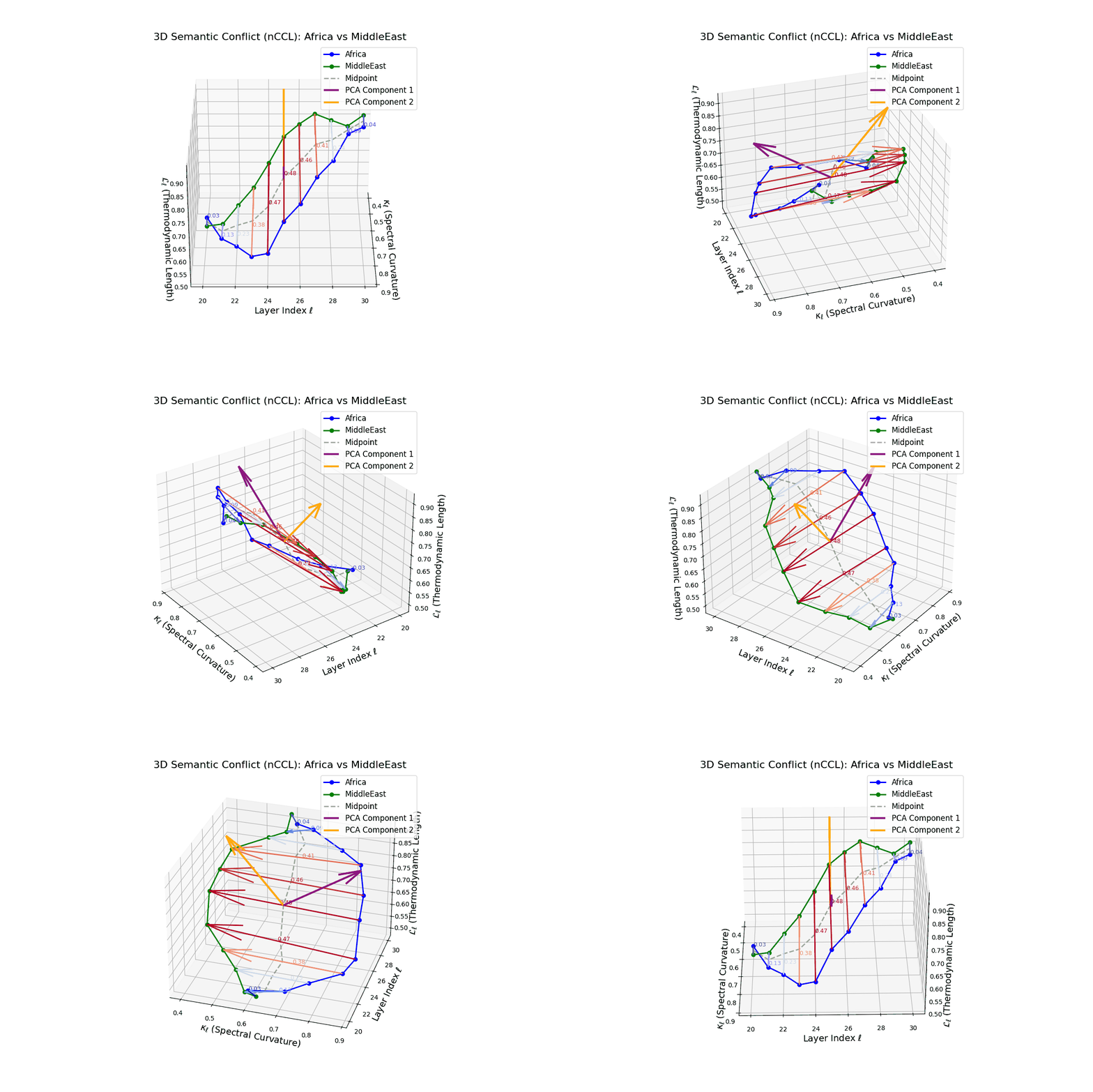
Let $x_\ell(\mathrm{Africa})$ and $x_\ell(\mathrm{MiddleEast})$ denote latent embeddings, and $x_\ell(\mathrm{Merged})$ the merged offspring embedding at layer $\ell$. The conflict $\Delta_\ell = \left|x_\ell(\mathrm{Merged}) - \Phi \left(x_\ell(\mathrm{Africa}), x_\ell(\mathrm{MiddleEast})\right)\right|$ is minimal in early layers $\ell \in [20, 21]$, reflecting conserved core semantics and lexical stability. Peaks in mid layers $\ell \in [22, 28]$ mark critical ideological tensions requiring alignment correction to reduce bias and maintain fidelity. Late layers $\ell \in [29, 30]$ show moderated conflict, representing semantic reconciliation vital for fair and robust culturally sensitive AI deployments.
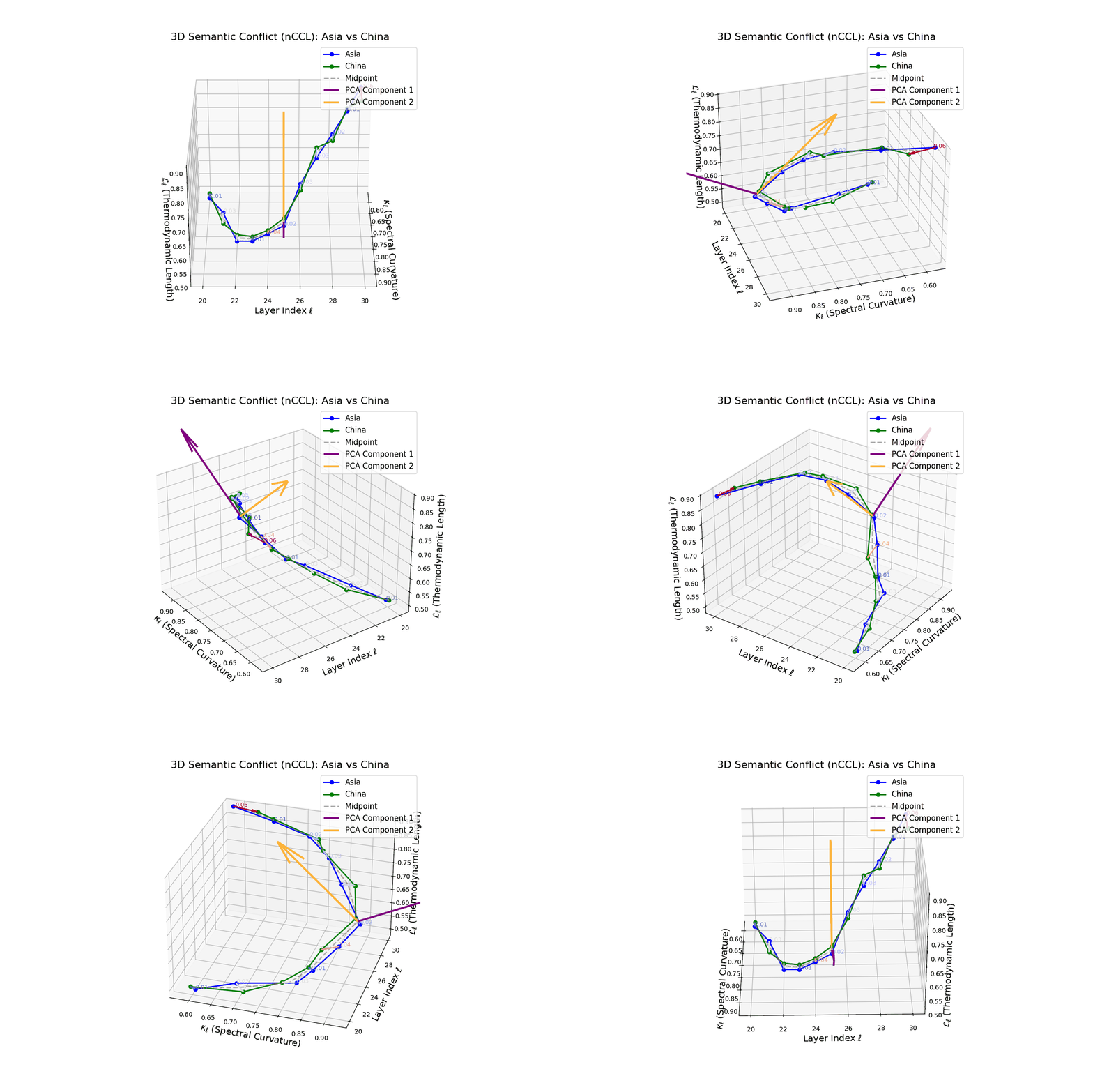
Let $x_\ell(\mathrm{Asia})$ and $x_\ell(\mathrm{China})$ denote latent embeddings for parent models representing Asian and Chinese cultural priors, with merged offspring embedding $x_\ell(\mathrm{Merged})$ at layer $\ell$. The conflict metric $\Delta_\ell = \left|x_\ell(\mathrm{Merged}) - \Phi \left(x_\ell(\mathrm{Asia}), x_\ell(\mathrm{China})\right)\right|$ remains low in early layers $\ell \in [20, 21]$, indicating stable inheritance and semantic alignment. Conflict intensifies sharply in mid layers $\ell \in [22, 28]$, highlighting strong ideological tension and semantic conflict. Late layers $\ell \in [29, 30]$ moderate, reflecting emergent semantic fusion and reconciliation, revealing critical latent zones for alignment vital to robust global AI fusion.
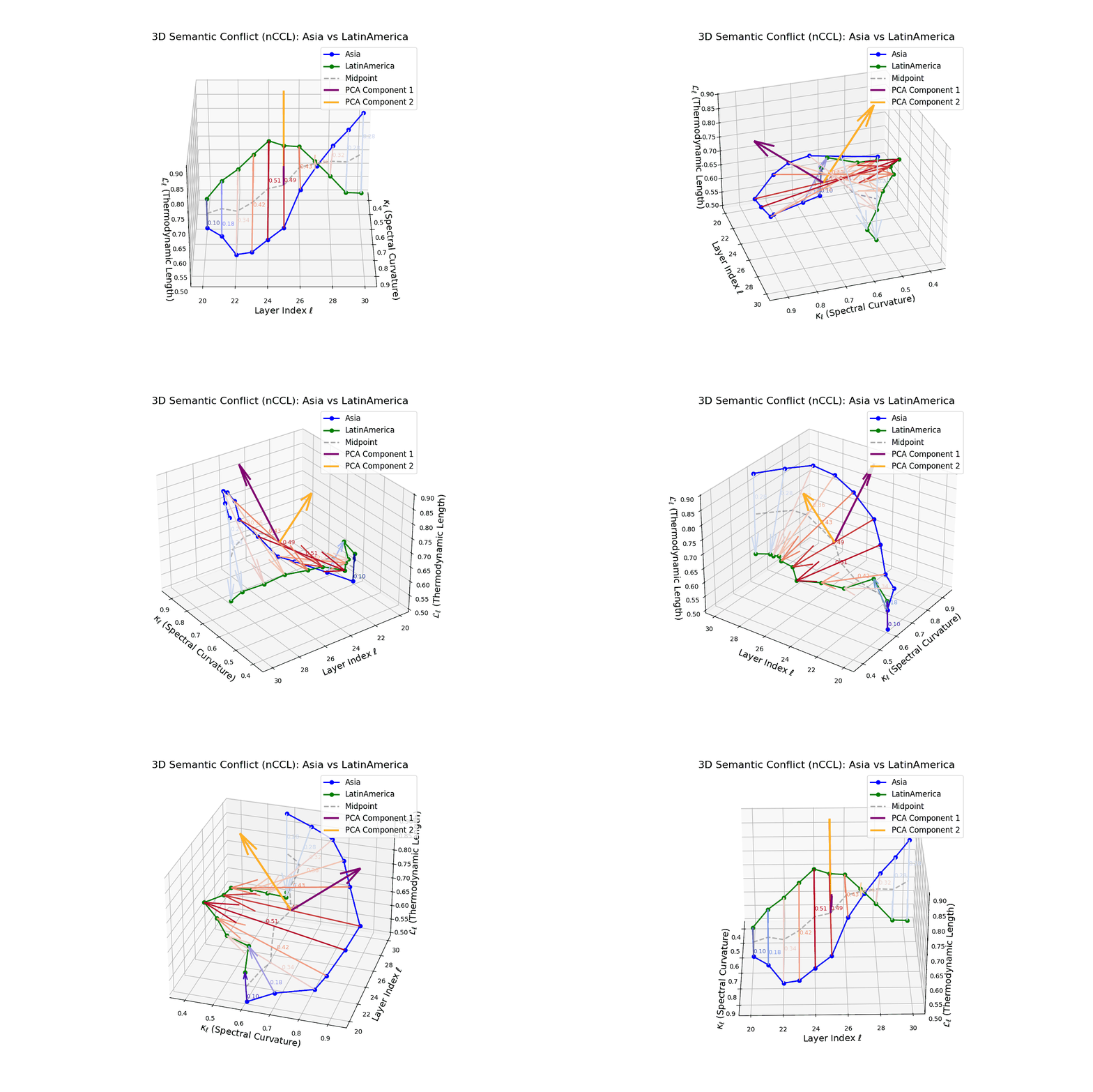
Let $x_\ell(\mathrm{Asia})$ and $x_\ell(\mathrm{LatinAmerica})$ denote latent embeddings for Asian and Latin American priors, with merged offspring embedding $x_\ell(\mathrm{Merged})$. The conflict $\Delta_\ell = \left|x_\ell(\mathrm{Merged}) - \Phi \left(x_\ell(\mathrm{Asia}), x_\ell(\mathrm{LatinAmerica})\right)\right|$ stays low in early layers $\ell \in [20, 21]$, showing preserved lexical and syntactic consistency. Conflict peaks in mid-todeep layers $\ell \in [22, 28]$, indicating semantic friction and ideological divergence needing precise alignment corrections. Late layers $\ell \in [29, 30]$ moderate, marking early semantic fusion and emergent expressivity.
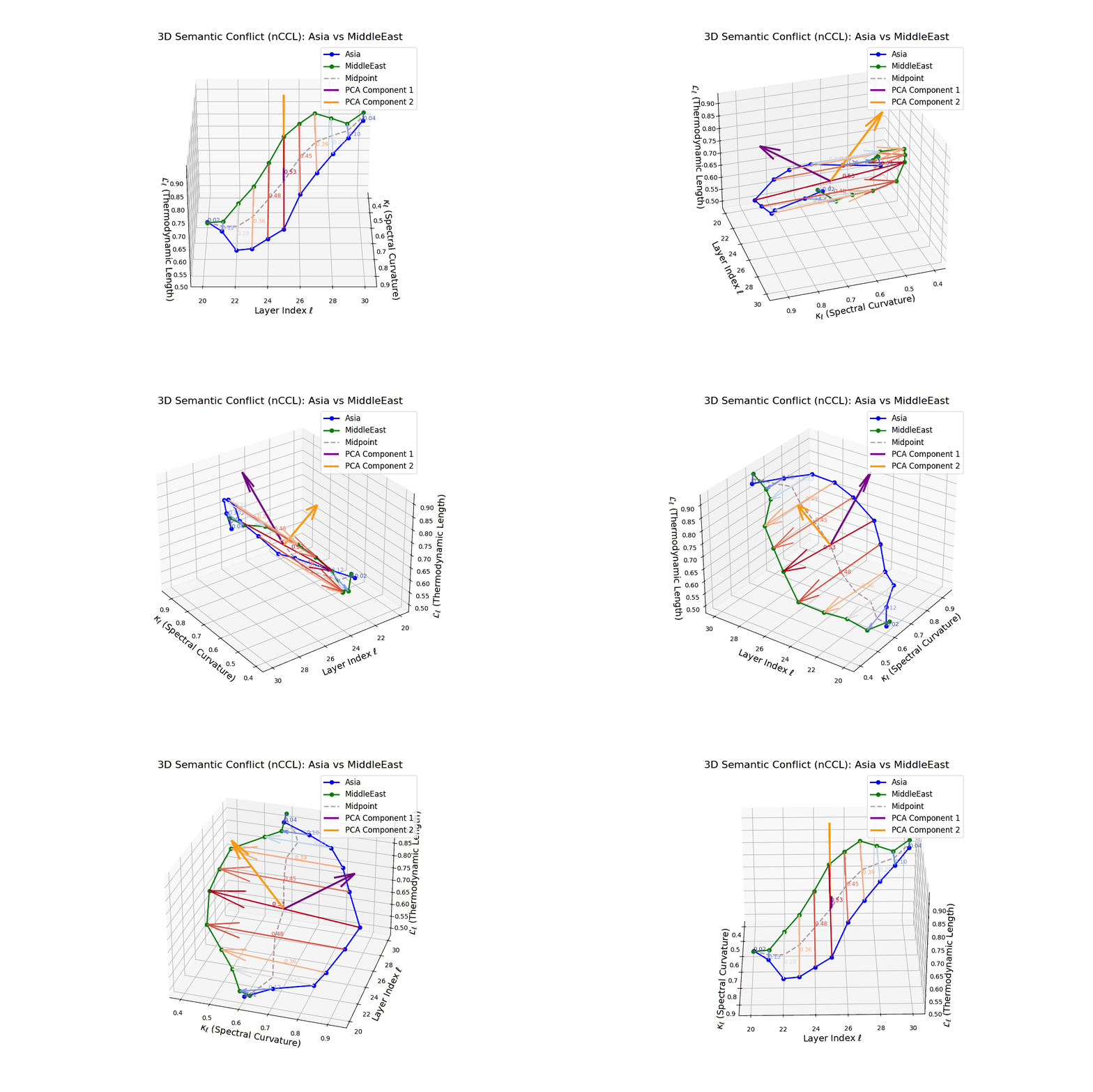
This shows semantic conflict between cultural priors of Asia and Middle East via embeddings $x_\ell(\mathrm{Asia})$, $x_\ell(\mathrm{MiddleEast})$, and merged $x_\ell(\mathrm{Merged})$. The conflict metric $\Delta_\ell = \left|x_\ell(\mathrm{Merged}) - \Phi \left(x_\ell(\mathrm{Asia}), x_\ell(\mathrm{MiddleEast})\right)\right|$ is minimal in early layers $\ell \in [20, 21]$, showing conserved semantics. Conflict escalates sharply in mid layers $\ell \in [22, 28]$, signaling profound ideological tension requiring semantic alignment. Conflict lessens moderately in late layers $\ell \in [29, 30]$, suggesting dynamic reconciliation. These patterns stress the need for targeted mitigation to uphold fairness and trust in global AI.
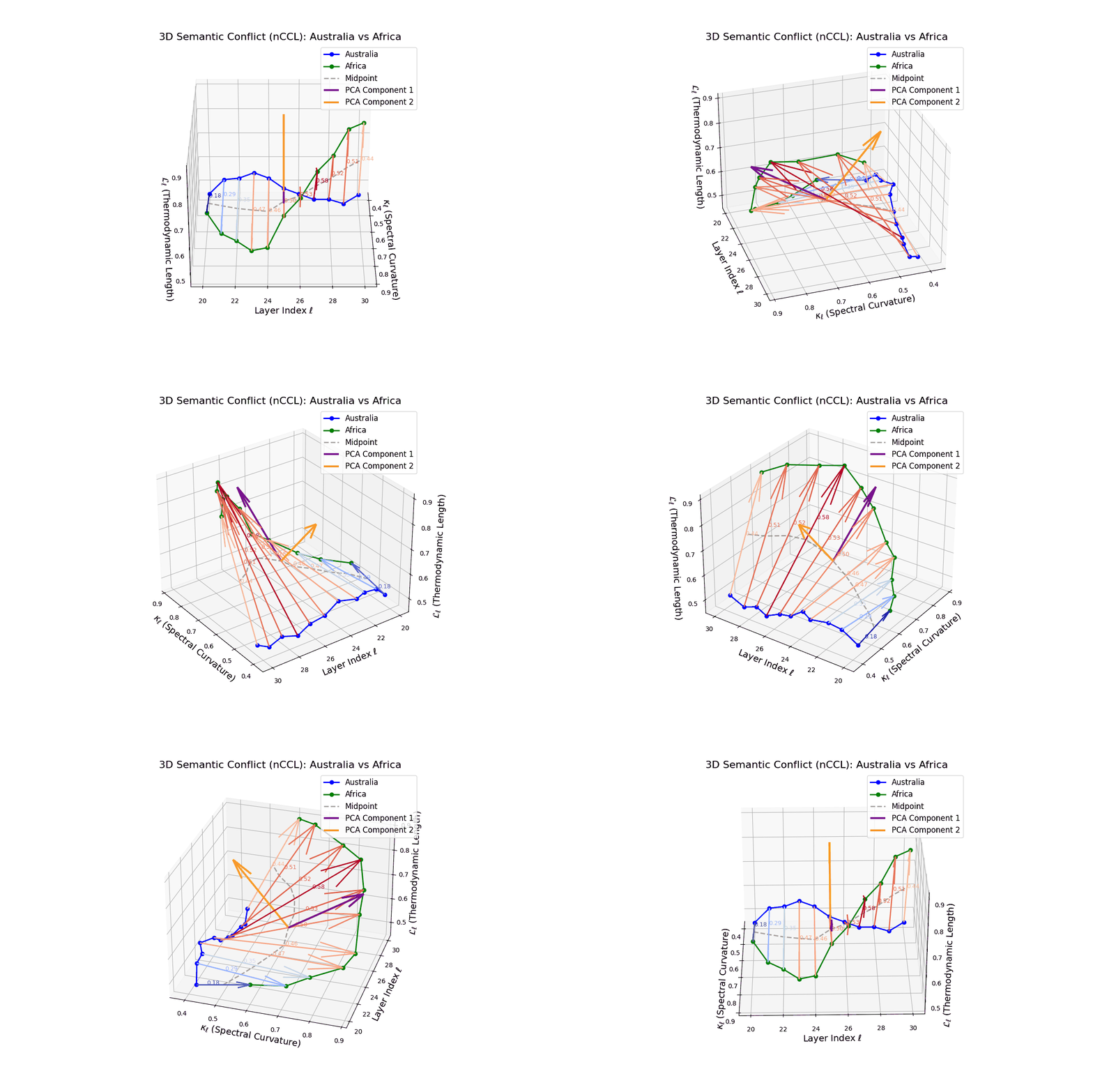
Latent embeddings $x_\ell(\mathrm{Australia})$ and $x_\ell(\mathrm{Africa})$ alongside merged $x_\ell(\mathrm{Merged})$ define conflict $\Delta_\ell = \left|x_\ell(\mathrm{Merged}) - \Phi \left(x_\ell(\mathrm{Australia}), x_\ell(\mathrm{Africa})\right)\right|$. This metric shows low conflict in early layers $\ell \in [20, 21]$, reflecting stable inheritance. Conflict rises in mid layers $\ell \in [22, 28]$, revealing ideological friction needing alignment interventions. Late layers $\ell \in [29, 30]$ moderate, showing emergent semantic fusion. These insights emphasize fine-grained, layer-specific tuning for culturally inclusive AI.

Let $x_\ell(\mathrm{Australia})$ and $x_\ell(\mathrm{Asia})$ denote latent embeddings at layer $\ell$ for parent models representing Australian and Asian cultural priors. Their merged offspring embedding $x_\ell(\mathrm{Merged})$ defines the conflict metric $\Delta_\ell = \left|x_\ell(\mathrm{Merged}) - \Phi \left(x_\ell(\mathrm{Australia}), x_\ell(\mathrm{Asia})\right)\right|$. Conflict remains low in early layers $\ell \in [20, 21]$, indicating stable inheritance and semantic alignment. It rises sharply in mid layers $\ell \in [22, 28]$, marking strong ideological tension and semantic conflict. Moderation in late layers $\ell \in [29, 30]$ reflects emergent semantic fusion. These patterns identify critical latent zones requiring culturally aware alignment and semantic harmonization for robust global AI fusion.

Let $x_\ell(\mathrm{Australia})$, $x_\ell(\mathrm{China})$, and merged $x_\ell(\mathrm{Merged})$ denote latent embeddings at layer $\ell$. The conflict $\Delta_\ell = \left|x_\ell(\mathrm{Merged}) - \Phi \left(x_\ell(\mathrm{Australia}), x_\ell(\mathrm{China})\right)\right|$ is minimal in early layers $\ell \in [20, 21]$, indicating stable inheritance of core semantics. Pronounced conflict arises in mid layers $\ell \in [22, 28]$, exposing latent ideological friction and semantic divergence needing focused, layerspecific alignment. Conflict moderates in late layers $\ell \in [29, 30]$, reflecting semantic fusion and emergent expressivity, highlighting non-uniform semantic integration.
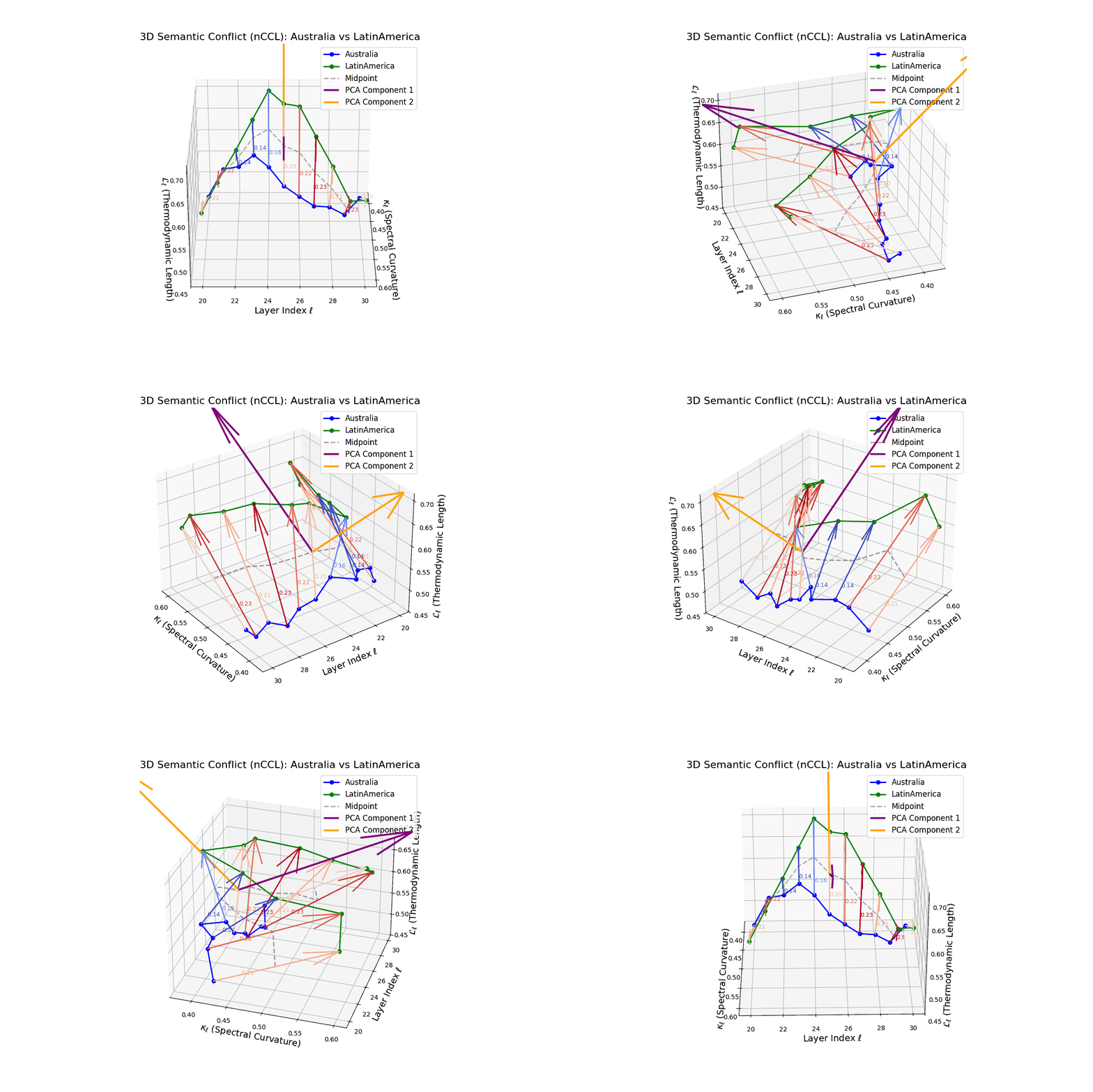
Let $x_\ell(\mathrm{Australia})$, $x_\ell(\mathrm{LatinAmerica})$, and merged $x_\ell(\mathrm{Merged})$ denote latent embeddings at layer $\ell$. The conflict metric $\Delta_\ell = \left|x_\ell(\mathrm{Merged}) - \Phi \left(x_\ell(\mathrm{Australia}), x_\ell(\mathrm{LatinAmerica})\right)\right|$ is subdued in early layers $\ell \in [20, 21]$, showing preserved core semantics. It intensifies sharply in mid layers $\ell \in [22, 28]$, marking pronounced ideological tension demanding explicit realignment. Conflict moderates late $\ell \in [29, 30]$, signaling early semantic fusion and underscoring need for layered semantic calibration in culturally sensitive AI.
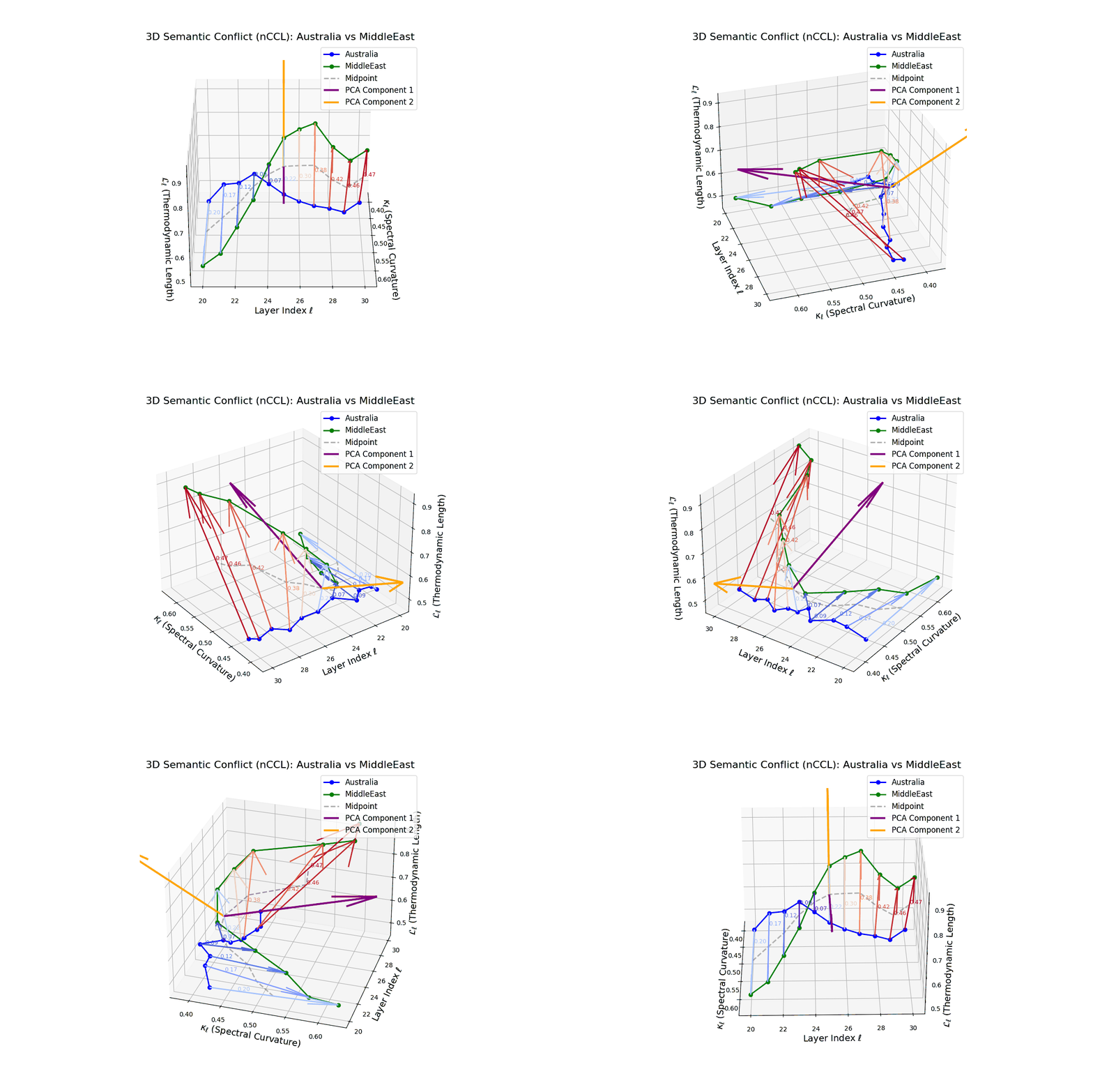
Let $x_\ell(\mathrm{Australia})$, $x_\ell(\mathrm{MiddleEast})$, and merged $x_\ell(\mathrm{Merged})$ denote latent embeddings at layer $\ell$. The conflict $\Delta_\ell = \left|x_\ell(\mathrm{Merged}) - \Phi \left(x_\ell(\mathrm{Australia}), x_\ell(\mathrm{MiddleEast})\right)\right|$ is minimal in early layers $\ell \in [20, 21]$, reflecting stable semantic inheritance. Conflict escalates prominently in mid layers $\ell \in [22, 28]$, exposing latent ideological tensions requiring targeted alignment. Moderated conflict in late layers $\ell \in [29, 30]$ indicates semantic integration and reconciliation. These dynamics highlight need for fine-grained, layer-specific alignment to ensure fairness and robustness in global AI deployments.
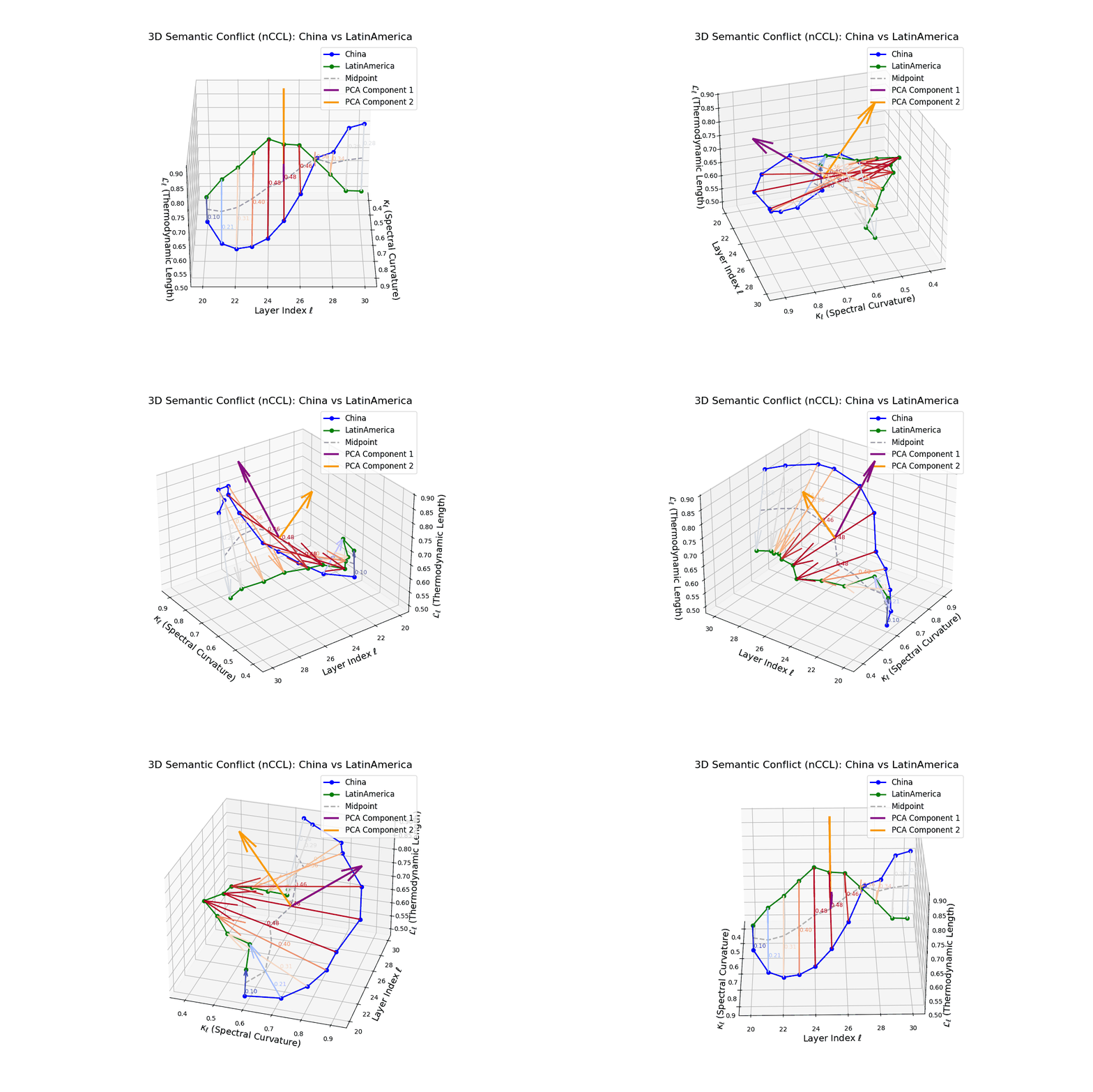
Let $x_\ell(\mathrm{China})$ and $x_\ell(\mathrm{LatinAmerica})$ denote latent embeddings at layer $\ell$ for parent models representing Chinese and Latin American cultural priors, respectively, with merged offspring embedding $x_\ell(\mathrm{Merged})$. The conflict metric $\Delta_\ell = \left|x_\ell(\mathrm{Merged}) - \Phi \left(x_\ell(\mathrm{China}), x_\ell(\mathrm{LatinAmerica})\right)\right|$ remains low in early layers $\ell \in [20, 21]$, indicating strong inheritance of core cultural semantics; rises sharply in mid layers $\ell \in [22, 28]$, showing ideological tension and semantic divergence; and moderately declines in late layers $\ell \in [29, 30]$, reflecting initial semantic fusion and emergent hybrid expressivity. These dynamics reveal the critical need for layer-specific alignment corrections to resolve complex cross-cultural conflicts.
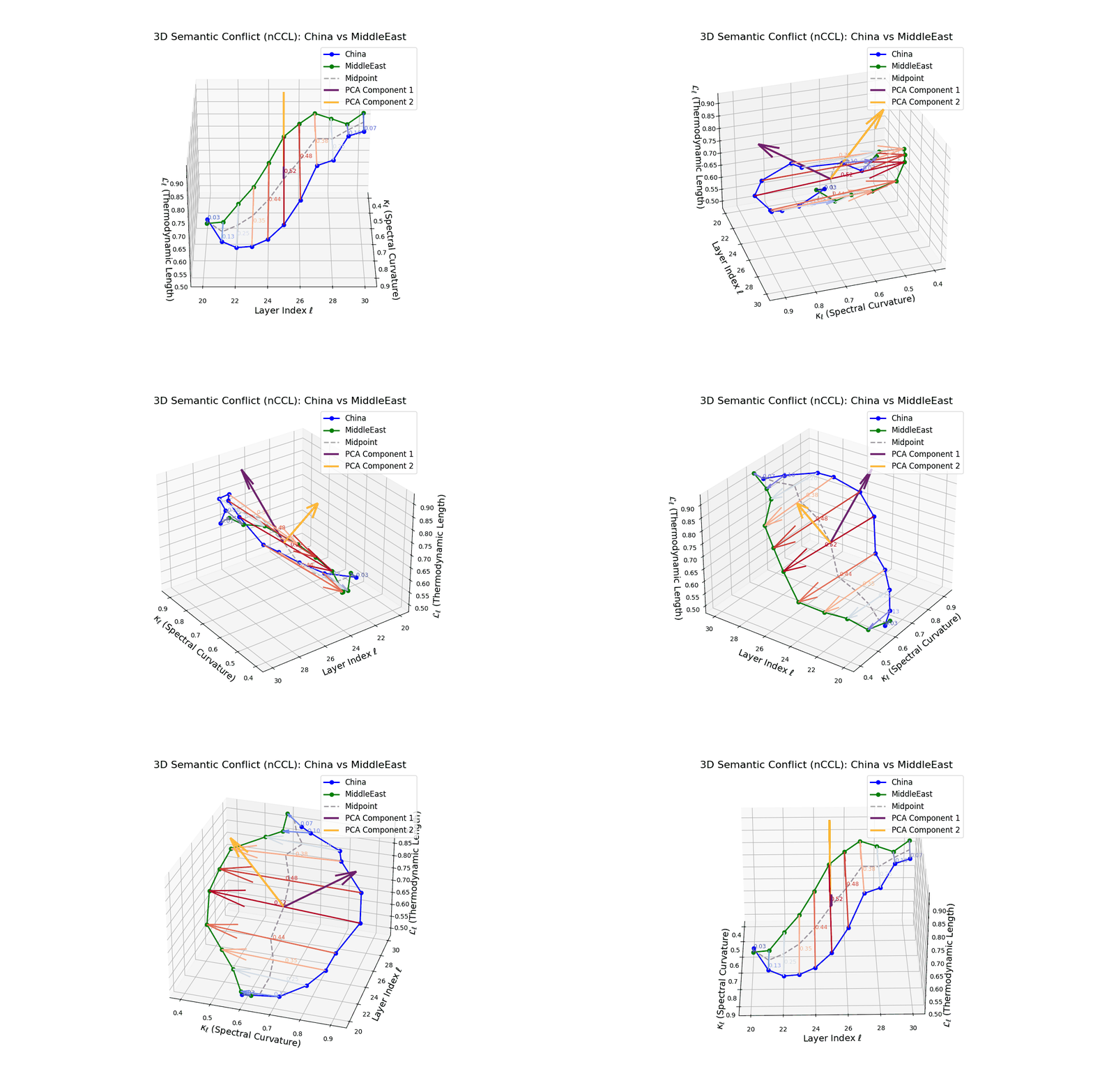
Latent embeddings $x_\ell(\mathrm{China})$ and $x_\ell(\mathrm{MiddleEast})$ for parent cultural priors, along with merged embedding $x_\ell(\mathrm{Merged})$, define conflict $\Delta_\ell = \left|x_\ell(\mathrm{Merged}) - \Phi \left(x_\ell(\mathrm{China}), x_\ell(\mathrm{MiddleEast})\right)\right|$. Conflict remains low in early layers $\ell \in [20, 21]$, reflecting stable semantic inheritance; rises notably in mid layers $\ell \in [22, 28]$, marking intense latent ideological friction requiring precise semantic recalibration; and reduces moderately in late layers $\ell \in [29, 30]$, indicating evolving semantic hybridization. This pattern highlights the essential role of depth-aware semantic alignment to promote cultural inclusivity and reduce bias in AI.
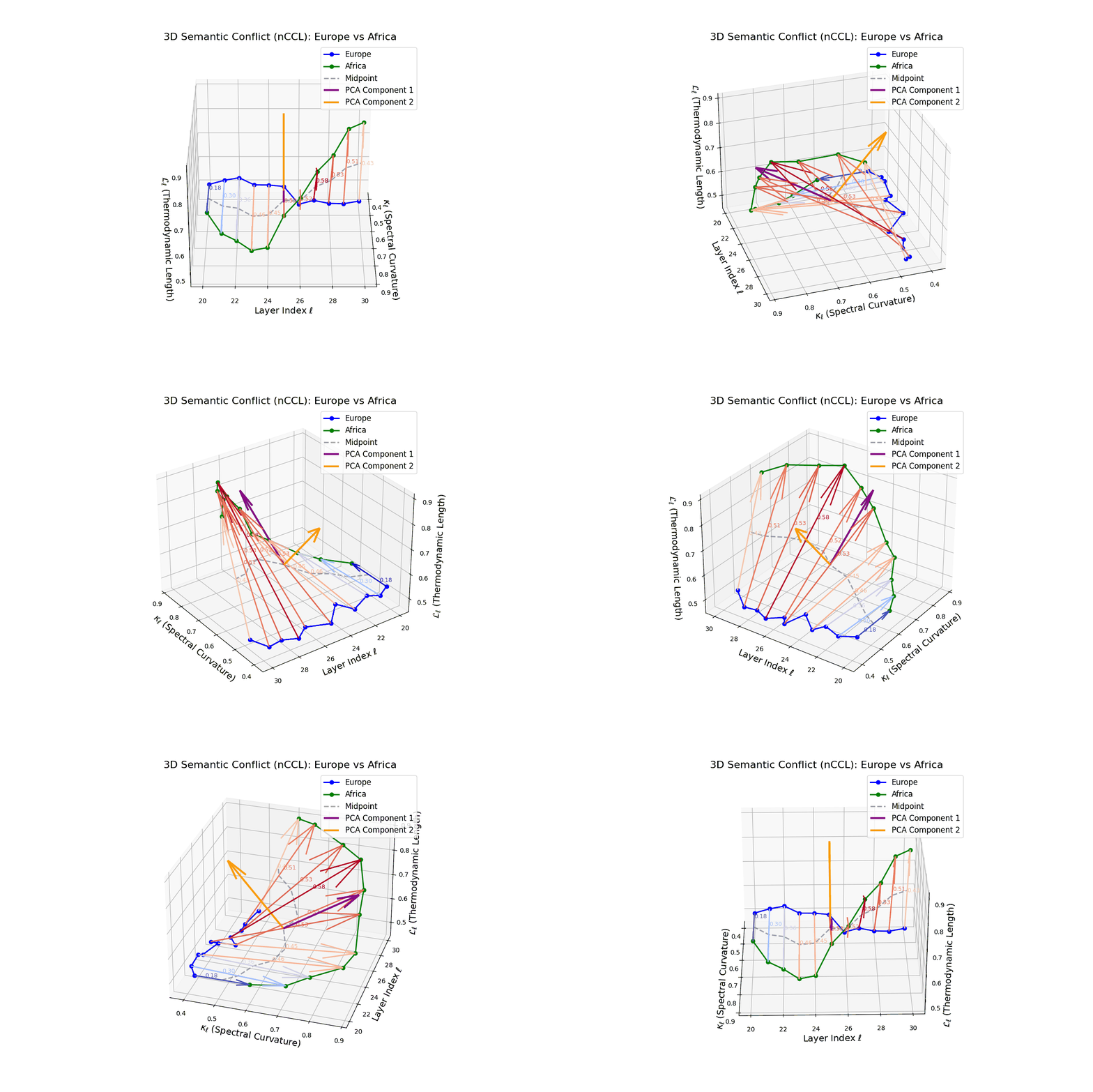
Latent embeddings $x_\ell(\mathrm{Europe})$, $x_\ell(\mathrm{Africa})$, and merged embedding $x_\ell(\mathrm{Merged})$ quantify conflict $\Delta_\ell = \left|x_\ell(\mathrm{Merged}) - \Phi \left(x_\ell(\mathrm{Europe}), x_\ell(\mathrm{Africa})\right)\right|$. $\Delta_\ell$ is low in early layers $\ell \in [20, 21]$, indicating preserved core semantics; rises significantly in mid layers $\ell \in [22, 28]$, showing semantic dissonance and ideological tension requiring targeted harmonization; and partially resolves in late layers $\ell \in [29, 30]$, marking emergent cross-cultural synthesis. These results demonstrate semantic fusion complexity and the need for layerwise semantic calibration to achieve equitable AI.

This figure shows semantic conflict $\Delta_\ell = \left|x_\ell(\mathrm{Merged}) - \Phi \left(x_\ell(\mathrm{Europe}), x_\ell(\mathrm{Asia})\right)\right|$ between parent embeddings $x_\ell(\mathrm{Europe})$ and $x_\ell(\mathrm{Asia})$, and merged offspring $x_\ell(\mathrm{Merged})$. Early layers $\ell \in [20, 21]$ show minimal conflict, reflecting conserved semantic features; mid layers $\ell \in [22, 28]$ reveal pronounced ideological tension and semantic divergence demanding focused alignment interventions; and late layers $\ell \in [29, 30]$ show moderated conflict, indicating ongoing semantic fusion and cultural reconciliation. These insights emphasize the depth-dependent nature of cross-cultural semantic integration.
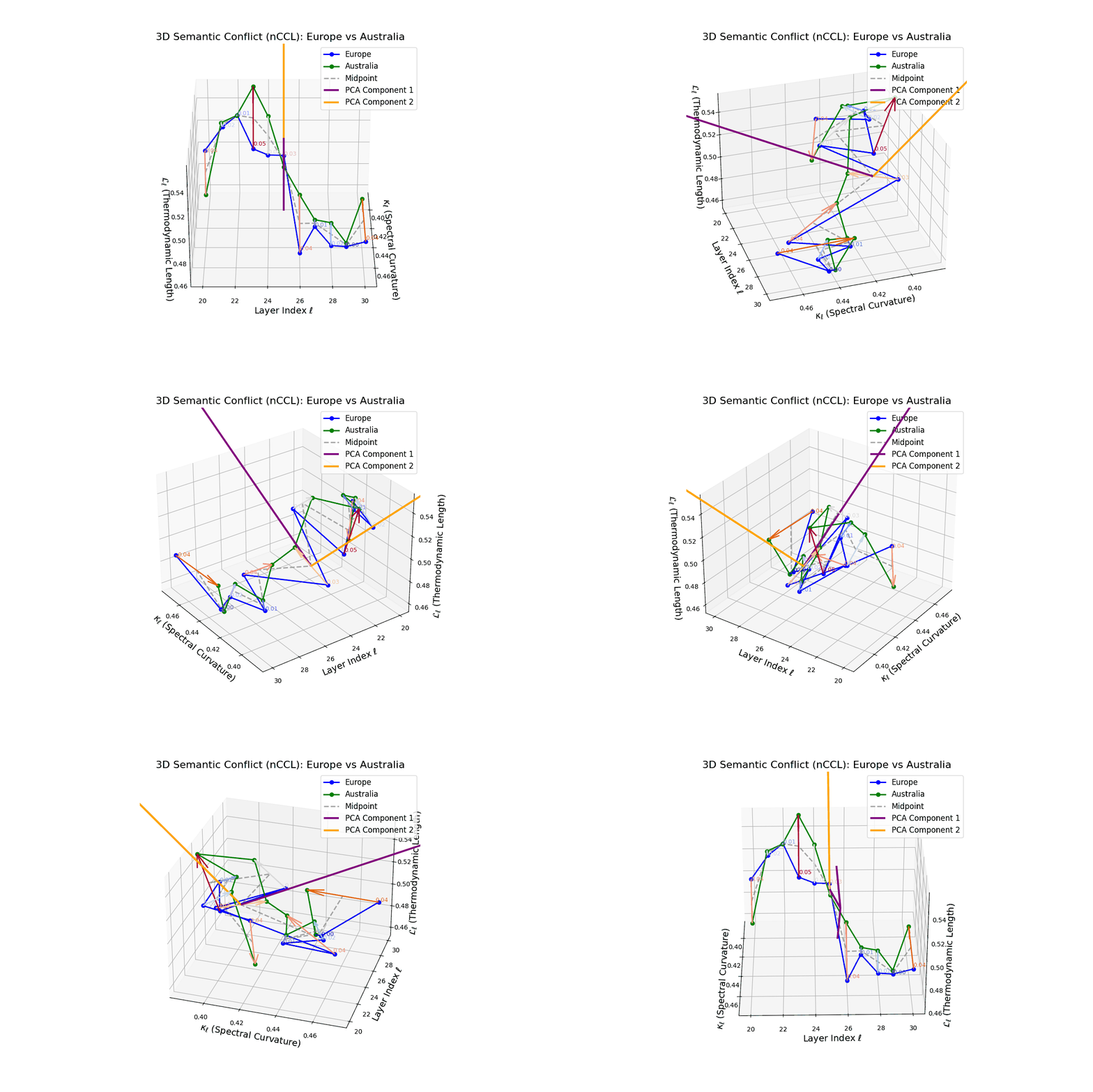
Let $x_\ell(\mathrm{Europe})$ and $x_\ell(\mathrm{Australia})$ denote latent semantic embeddings at layer $\ell$ for parent models representing European and Australian cultural priors. Their merged offspring embedding $x_\ell(\mathrm{Merged})$ defines the layerwise semantic conflict metric $\Delta_\ell = \left|x_\ell(\mathrm{Merged}) - \Phi \left(x_\ell(\mathrm{Europe}), x_\ell(\mathrm{Australia})\right)\right|$. Conflict stays low in early layers $\ell \in [20, 21]$, showing stable cultural inheritance and semantic alignment. It sharpens in mid layers $\ell \in [22, 28]$, marking strong ideological tension and semantic conflict. Conflict eases in late layers $\ell \in [29, 30]$, reflecting emergent semantic fusion and reconciliation. These dynamics identify critical latent zones for targeted semantic harmonization and culturally aware alignment essential for robust, coherent AI integration.

Latent embeddings $x_\ell(\mathrm{Europe})$ and $x_\ell(\mathrm{China})$ for parent cultural priors, with merged offspring $x_\ell(\mathrm{Merged})$, yield conflict $\Delta_\ell = \left|x_\ell(\mathrm{Merged}) - \Phi \left(x_\ell(\mathrm{Europe}), x_\ell(\mathrm{China})\right)\right|$. Conflict is low in early layers $\ell \in [20, 21]$, showing preserved lexical and syntactic consistency. It intensifies in mid layers $\ell \in [22, 28]$, highlighting semantic friction and ideological divergence needing precise, layer-specific alignment corrections. Conflict eases in late layers $\ell \in [29, 30]$, signaling early semantic fusion and emergent cross-cultural expressivity. This layered profile highlights the need for nuanced semantic calibration for culturally sensitive, fair AI.
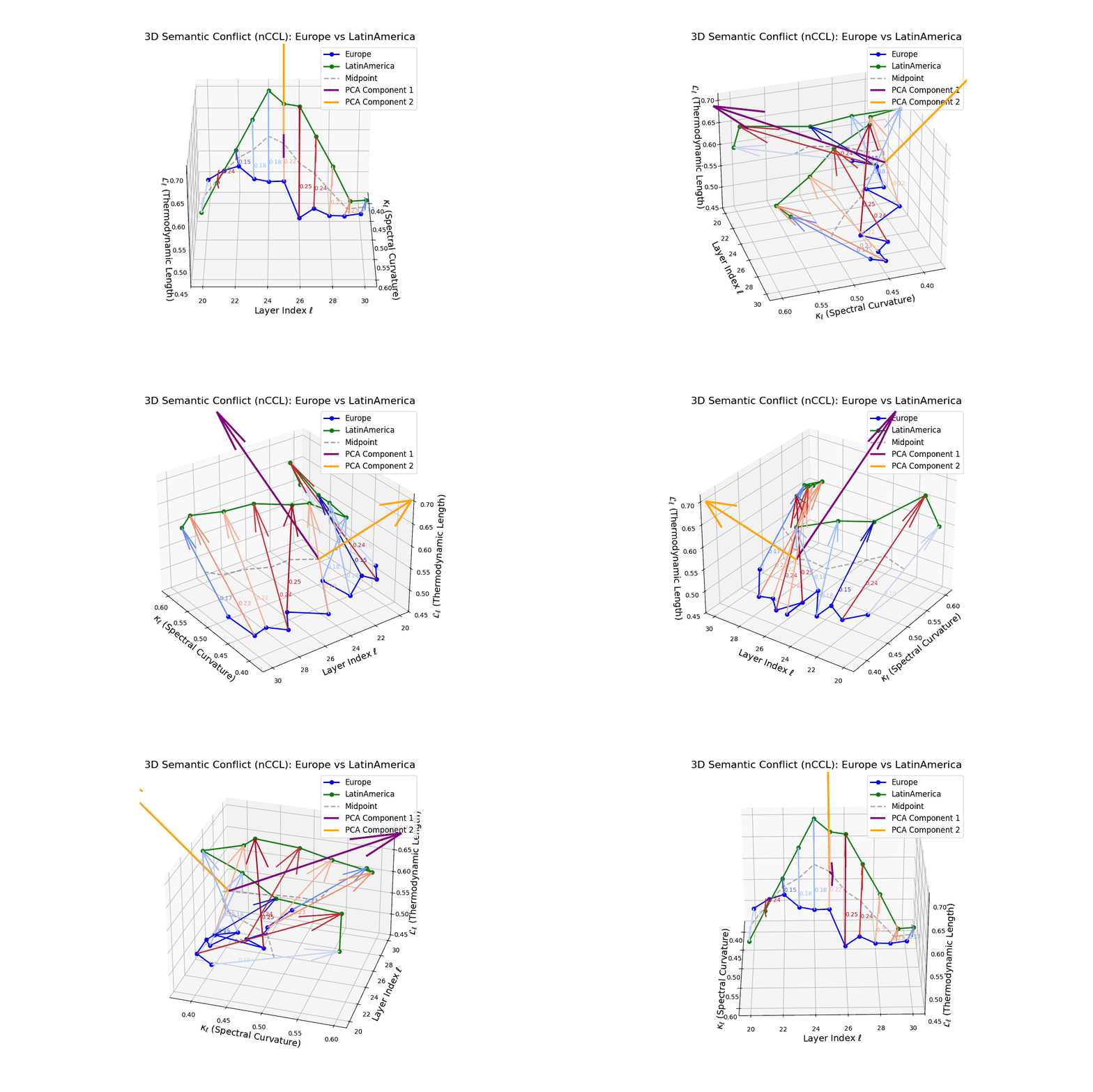
This figure shows latent embeddings $x_\ell(\mathrm{Europe})$, $x_\ell(\mathrm{LatinAmerica})$, and merged offspring $x_\ell(\mathrm{Merged})$, with conflict metric $\Delta_\ell = \left|x_\ell(\mathrm{Merged}) - \Phi \left(x_\ell(\mathrm{Europe}), x_\ell(\mathrm{LatinAmerica})\right)\right|$. Conflict is low in early layers $\ell \in [20, 21]$, reflecting conserved semantic features. It escalates through mid layers $\ell \in [22, 28]$, revealing latent ideological tension requiring semantic alignment. Conflict lowers in late layers $\ell \in [29, 30]$, indicating semantic reconciliation. These dynamics highlight the importance of targeted mitigation to uphold fairness and trust in global AI.
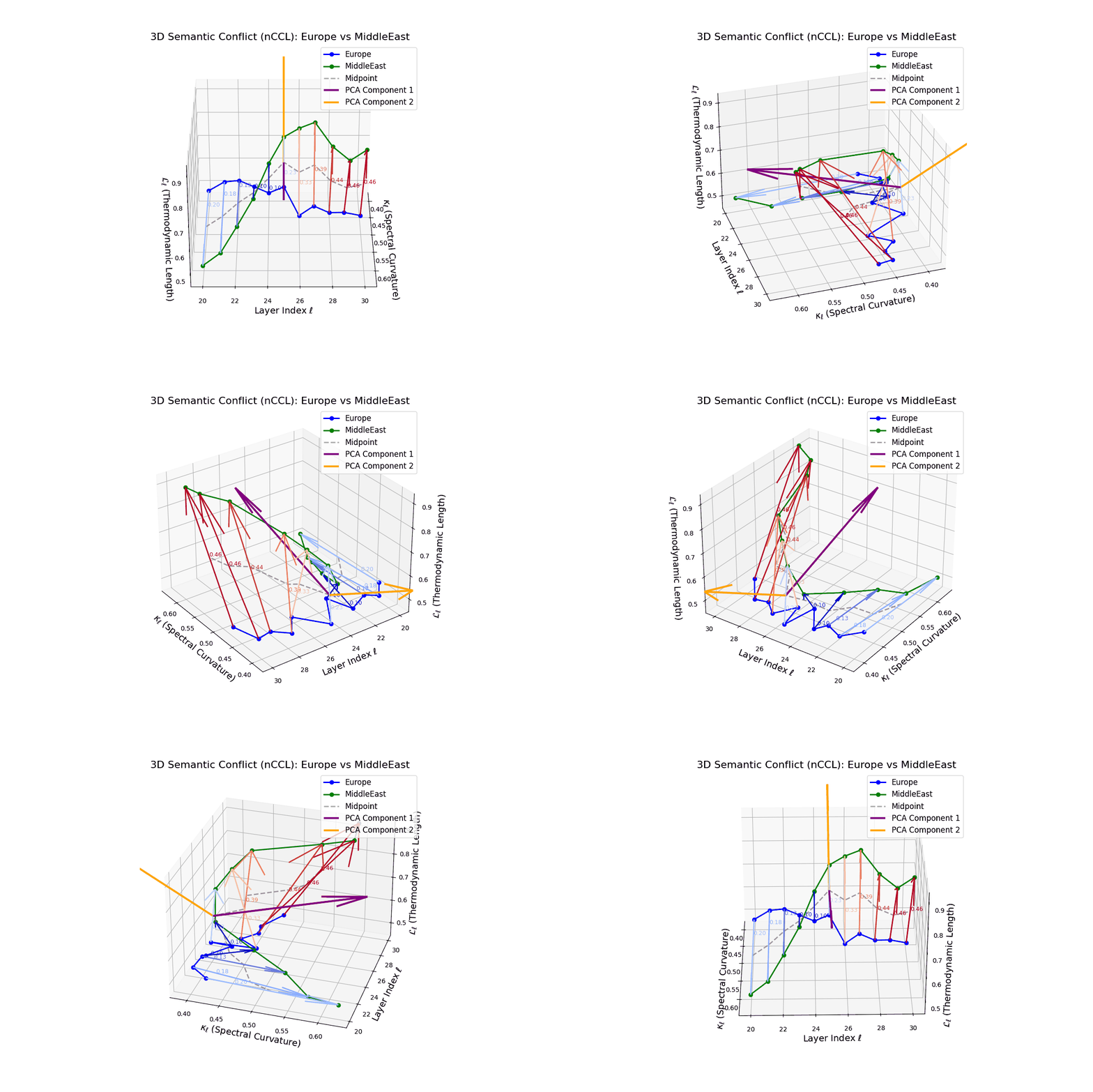
Latent embeddings $x_\ell(\mathrm{Europe})$ and $x_\ell(\mathrm{MiddleEast})$, with merged $x_\ell(\mathrm{Merged})$, yield conflict $\Delta_\ell = \left|x_\ell(\mathrm{Merged}) - \Phi \left(x_\ell(\mathrm{Europe}), x_\ell(\mathrm{MiddleEast})\right)\right|$. Conflict is low in early layers $\ell \in [20, 21]$, showing stable inheritance of core semantics. It intensifies in mid layers $\ell \in [22, 28]$, revealing latent ideological friction needing alignment interventions. Conflict moderates in late layers $\ell \in [29, 30]$, reflecting emergent semantic fusion and reconciliation. These insights stress the importance of fine-grained, layer-specific tuning for culturally inclusive, semantically robust AI systems.
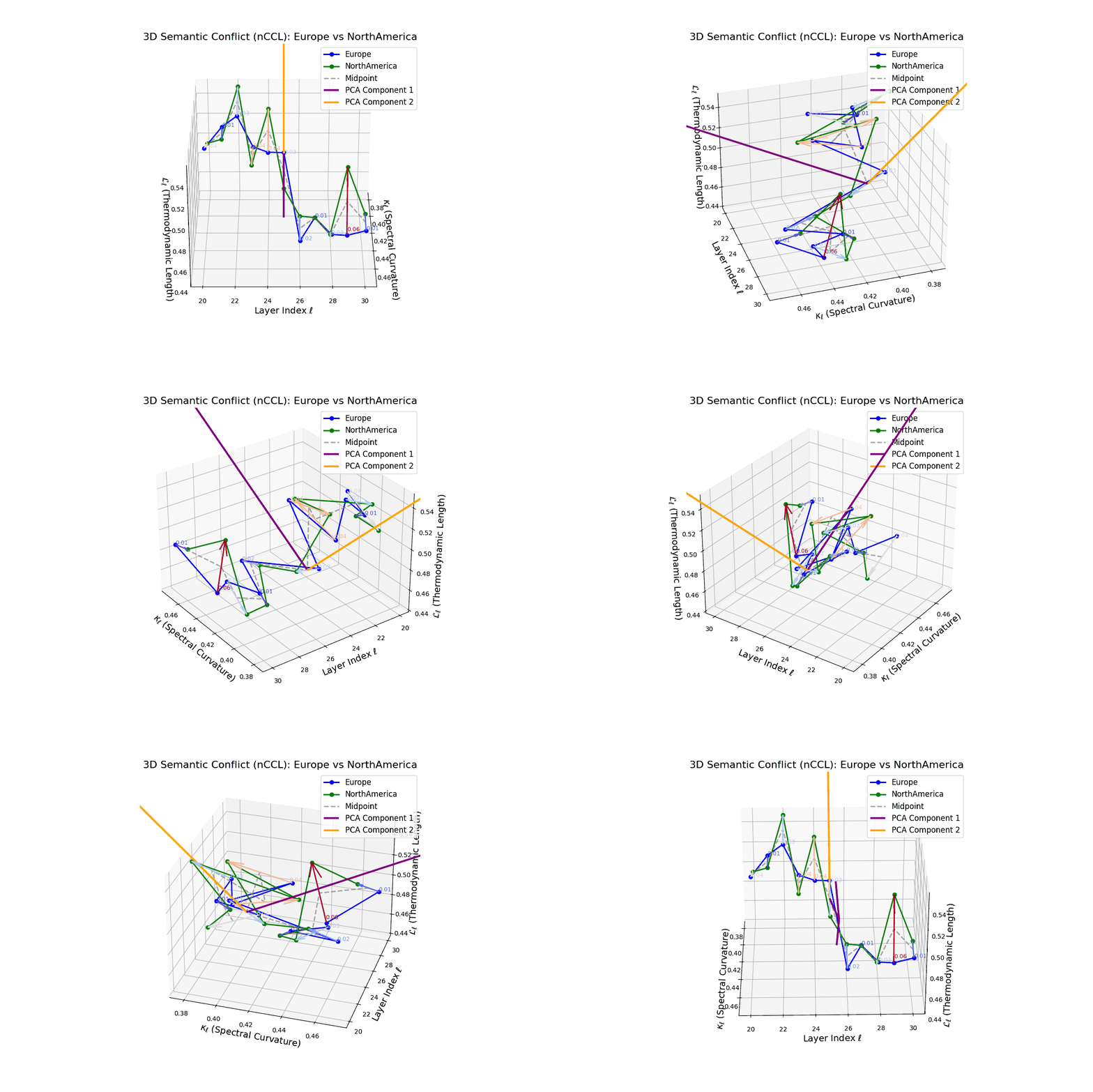
The latent semantic embeddings $x_\ell(\mathrm{Europe})$ and $x_\ell(\mathrm{NorthAmerica})$ at layer $\ell$, together with merged offspring embedding $x_\ell(\mathrm{Merged})$, define the semantic conflict metric $\Delta_\ell = \left|x_\ell(\mathrm{Merged}) - \Phi \left(x_\ell(\mathrm{Europe}), x_\ell(\mathrm{NorthAmerica})\right)\right|$. Low conflict levels in early layers $\ell \in [20, 21]$ indicate stable inheritance of core semantic features. The conflict escalates notably in mid layers $\ell \in [22, 28]$, highlighting latent ideological tension that necessitates precise semantic alignment. Moderation of conflict in late layers $\ell \in [29, 30]$ suggests emergent semantic fusion and cultural reconciliation, emphasizing the importance of layer-wise alignment strategies.
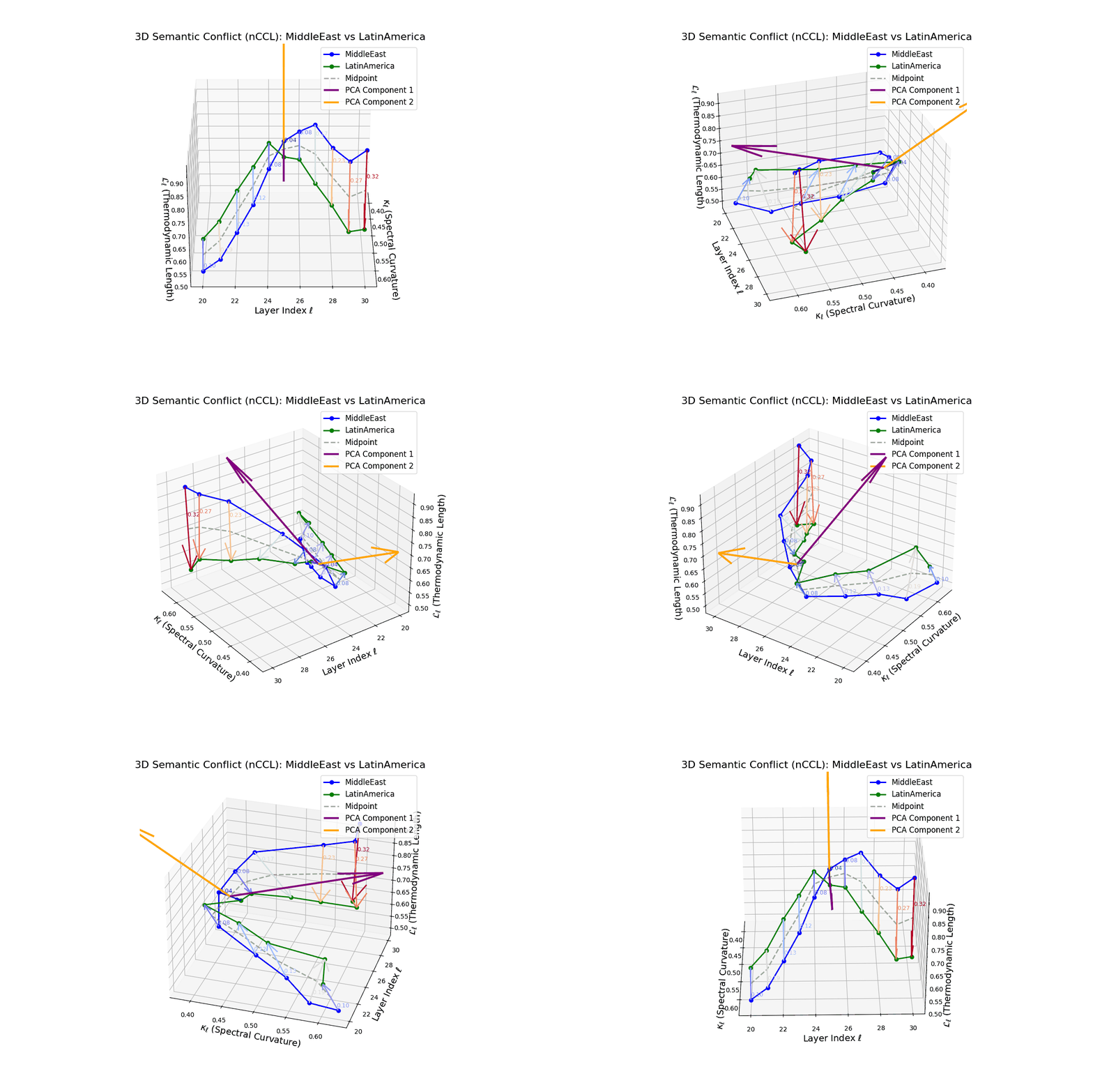
Let $x_\ell(\mathrm{MiddleEast})$ and $x_\ell(\mathrm{LatinAmerica})$ denote the latent semantic embeddings, and $x_\ell(\mathrm{Merged})$ the merged offspring embedding at layer $\ell$. The conflict $\Delta_\ell = \left|x_\ell(\mathrm{Merged}) - \Phi \left(x_\ell(\mathrm{MiddleEast}), x_\ell(\mathrm{LatinAmerica})\right)\right|$ remains low in early layers $\ell \in [20, 21]$, reflecting stable core semantics. Rising conflict in mid layers $\ell \in [22, 28]$ marks significant ideological divergence requiring careful semantic tuning. Late layer moderation $\ell \in [29, 30]$ indicates partial semantic integration, underscoring the need for nuanced layer-specific alignment for culturally robust AI models.
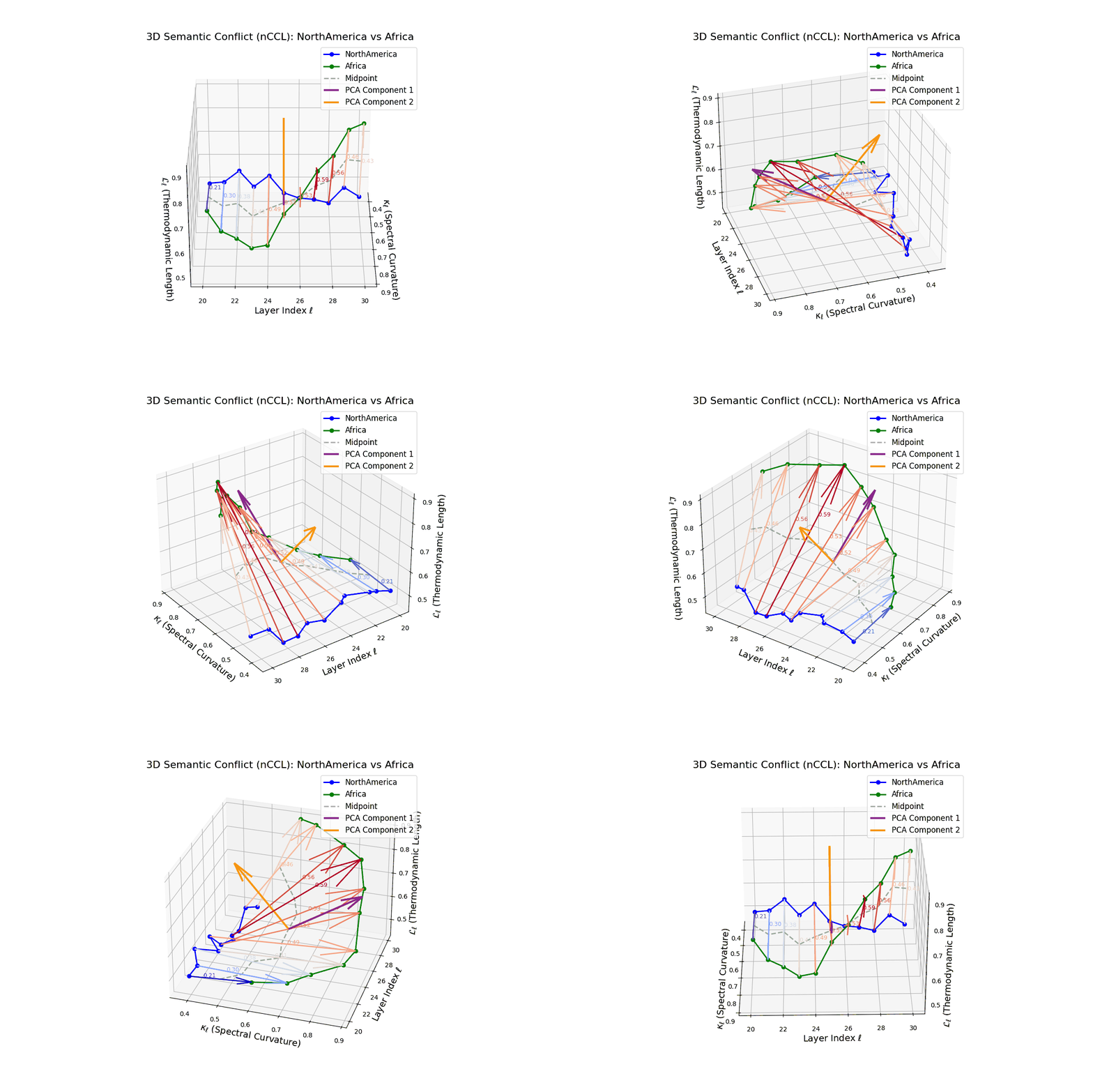
The latent embeddings $x_\ell(\mathrm{NorthAmerica})$ and $x_\ell(\mathrm{Africa})$, along with merged offspring $x_\ell(\mathrm{Merged})$, define semantic conflict $\Delta_\ell = \left|x_\ell(\mathrm{Merged}) - \Phi \left(x_\ell(\mathrm{NorthAmerica}), x_\ell(\mathrm{Africa})\right)\right|$. Initial layers $\ell \in [20, 21]$ show minimal conflict indicating preserved semantic traits. Mid layers $\ell \in [22, 28]$ exhibit heightened conflict, signaling latent ideological tension demanding semantic alignment interventions. Conflict moderates in late layers $\ell \in [29, 30]$, suggesting emergent fusion and reconciliation processes, highlighting the layered nature of cultural semantic integration.
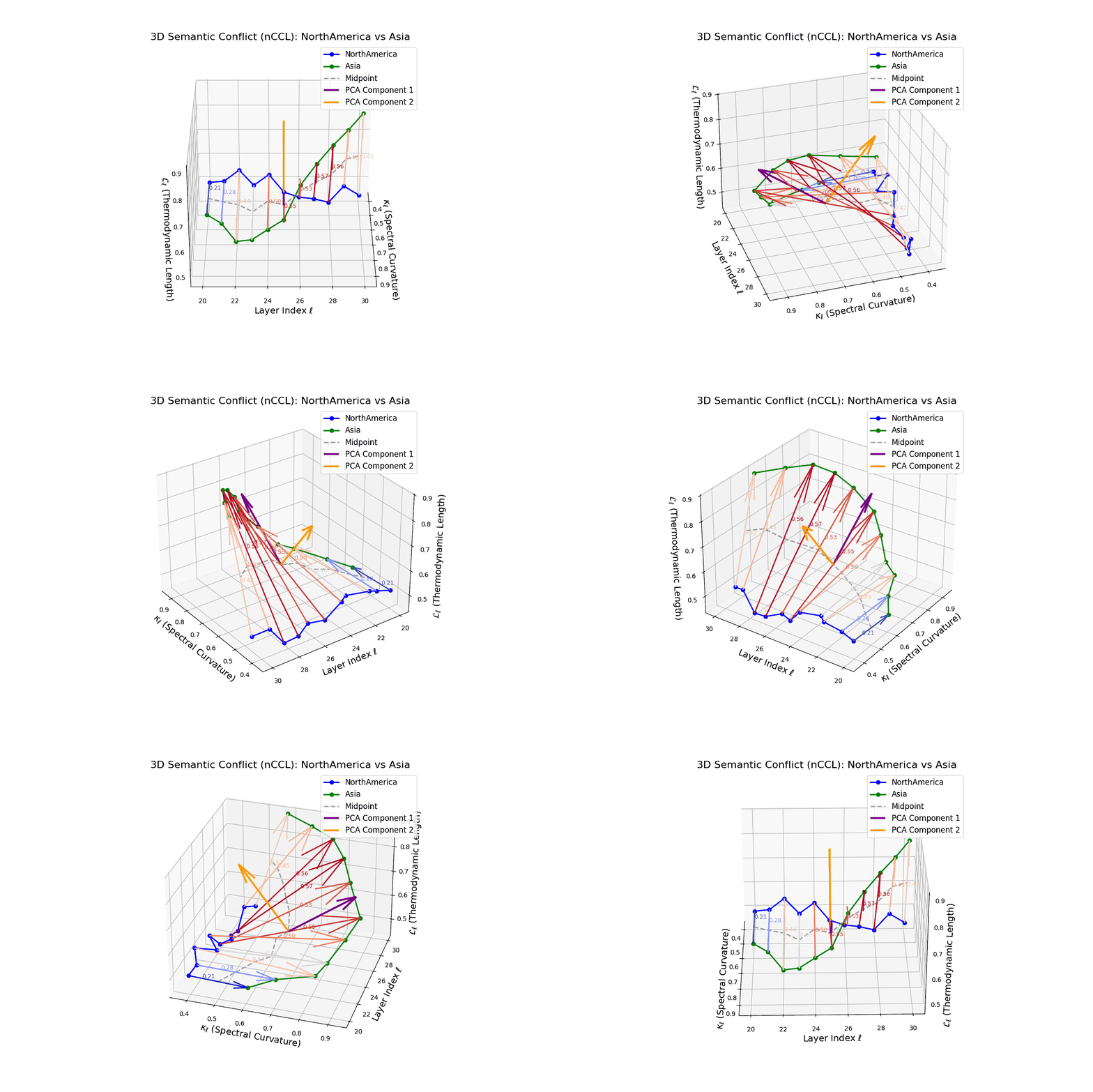
This figure presents the semantic conflict $\Delta_\ell = \left|x_\ell(\mathrm{Merged}) - \Phi \left(x_\ell(\mathrm{NorthAmerica}), x_\ell(\mathrm{Asia})\right)\right|$ computed from latent embeddings $x_\ell(\mathrm{NorthAmerica})$, $x_\ell(\mathrm{Asia})$, and merged $x_\ell(\mathrm{Merged})$. Low conflict is observed in early layers $\ell \in [20, 21]$, consistent with conserved lexical and syntactic features. Conflict intensifies in mid layers $\ell \in [22, 28]$, indicating significant semantic tension. Late layers $\ell \in [29, 30]$ show reduced conflict, marking the onset of semantic fusion. This layered profile highlights critical regions for targeted, culturally aware semantic alignment.

$x_\ell(\mathrm{NorthAmerica})$ and $x_\ell(\mathrm{Australia})$, merged offspring $x_\ell(\mathrm{Merged})$, conflict metric $\Delta_\ell = \left|x_\ell(\mathrm{Merged}) - \Phi \left(x_\ell(\mathrm{NorthAmerica}), x_\ell(\mathrm{Australia})\right)\right|$. Conflict is low in layers $\ell \in [20, 21]$, rises sharply mid layers $\ell \in [22, 28]$ showing semantic tension, then declines late $\ell \in [29, 30]$, indicating partial resolution.
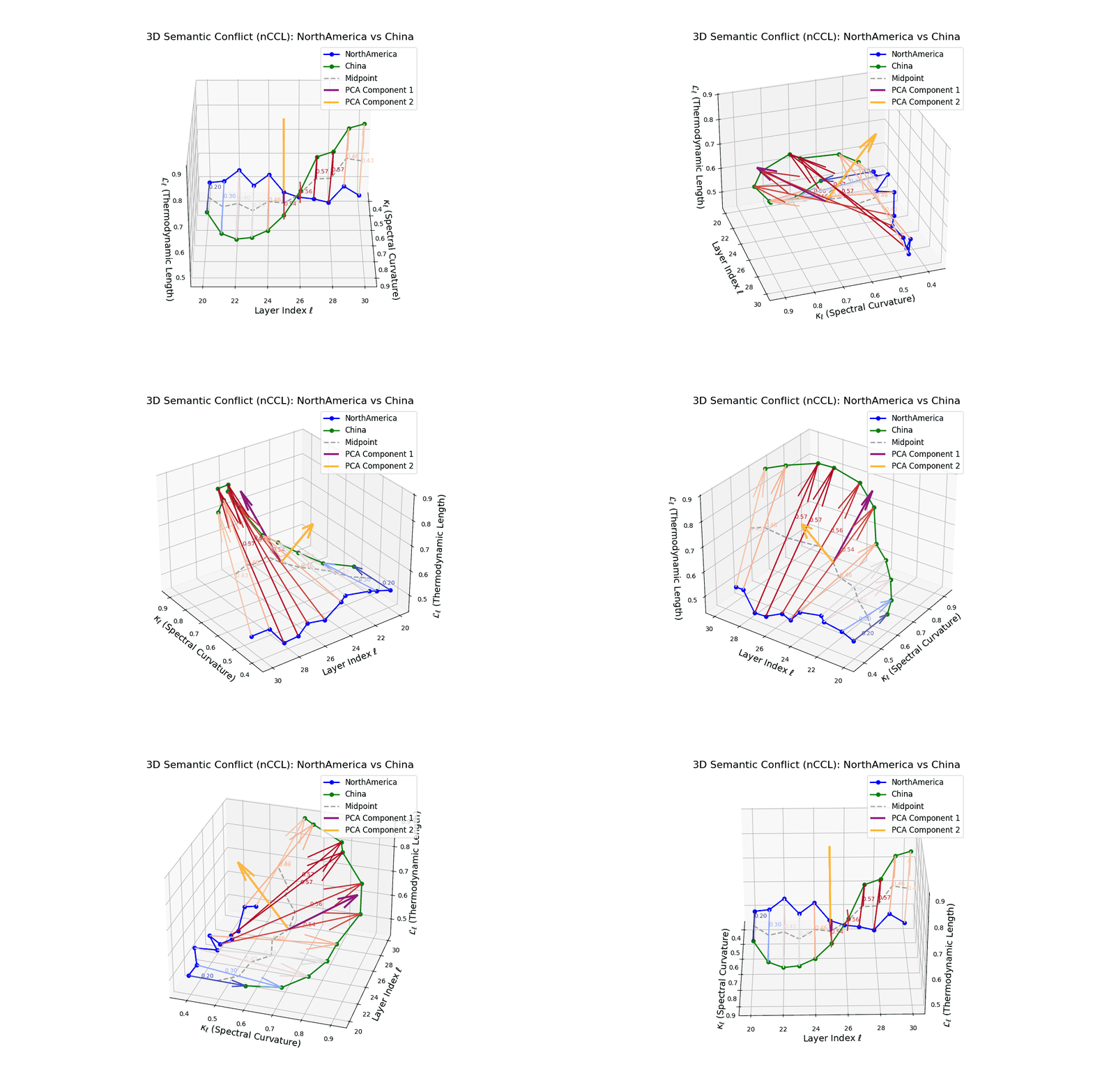
$x_\ell(\mathrm{NorthAmerica})$, $x_\ell(\mathrm{China})$, and $x_\ell(\mathrm{Merged})$ yield conflict $\Delta_\ell = \left|x_\ell(\mathrm{Merged}) - \Phi \left(x_\ell(\mathrm{NorthAmerica}), x_\ell(\mathrm{China})\right)\right|$. Layers $\ell \in [20, 21]$ have low conflict, mid layers $\ell \in [22, 28]$ exhibit sharp conflict spikes due to ideological friction, and late layers $\ell \in [29, 30]$ show moderation – semantic integration.
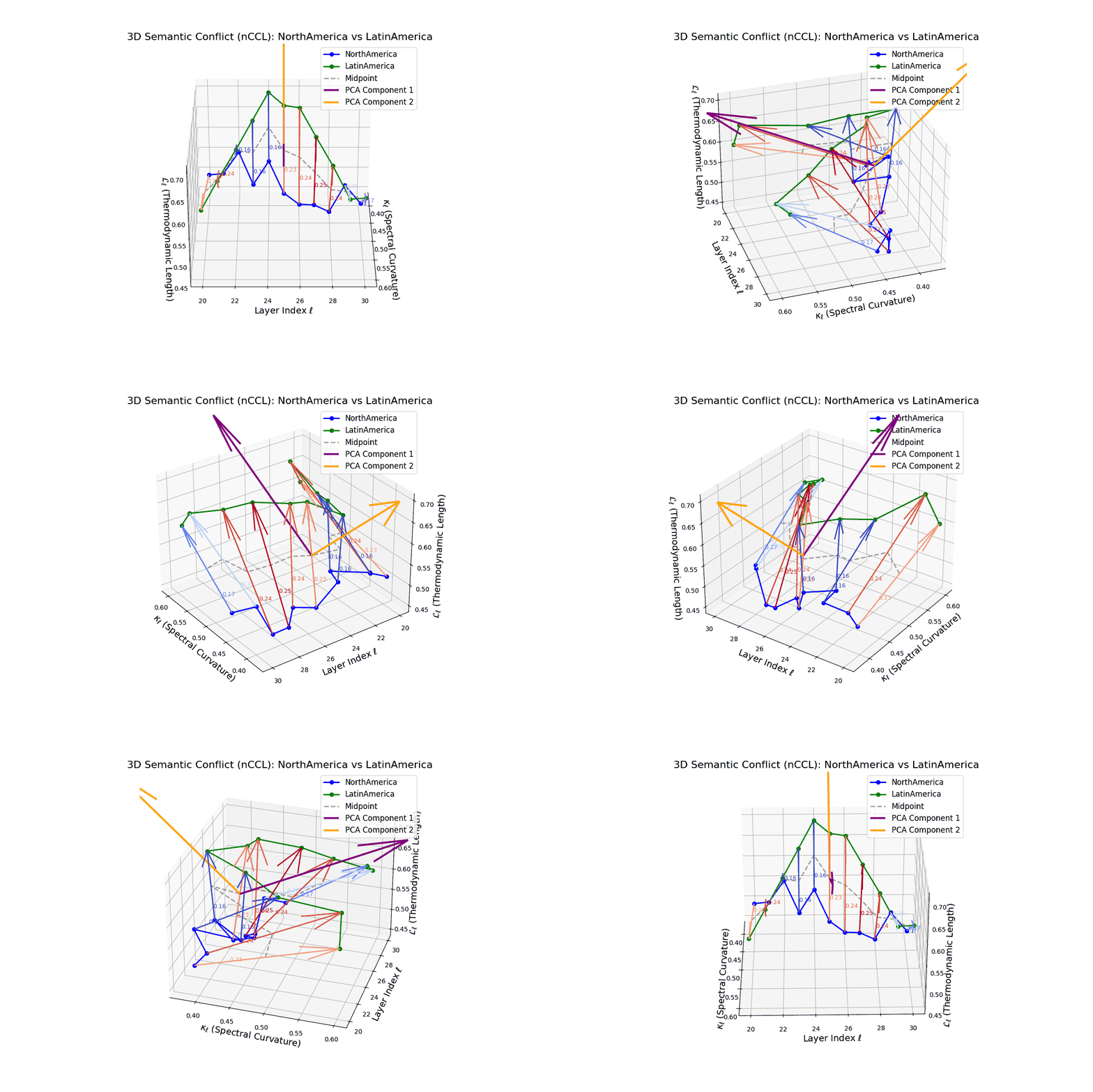
$x_\ell(\mathrm{NorthAmerica})$, $x_\ell(\mathrm{LatinAmerica})$, and $x_\ell(\mathrm{Merged})$ – $\Delta_\ell = \left|x_\ell(\mathrm{Merged}) - \Phi \left(x_\ell(\mathrm{NorthAmerica}), x_\ell(\mathrm{LatinAmerica})\right)\right|$. Conflict is low early $\ell \in [20, 21]$, rises sharply mid $\ell \in [22, 28]$, and tapers late $\ell \in [29, 30]$. These shifts reflect semantic tensions and fusion phases, calling for nuanced alignment.
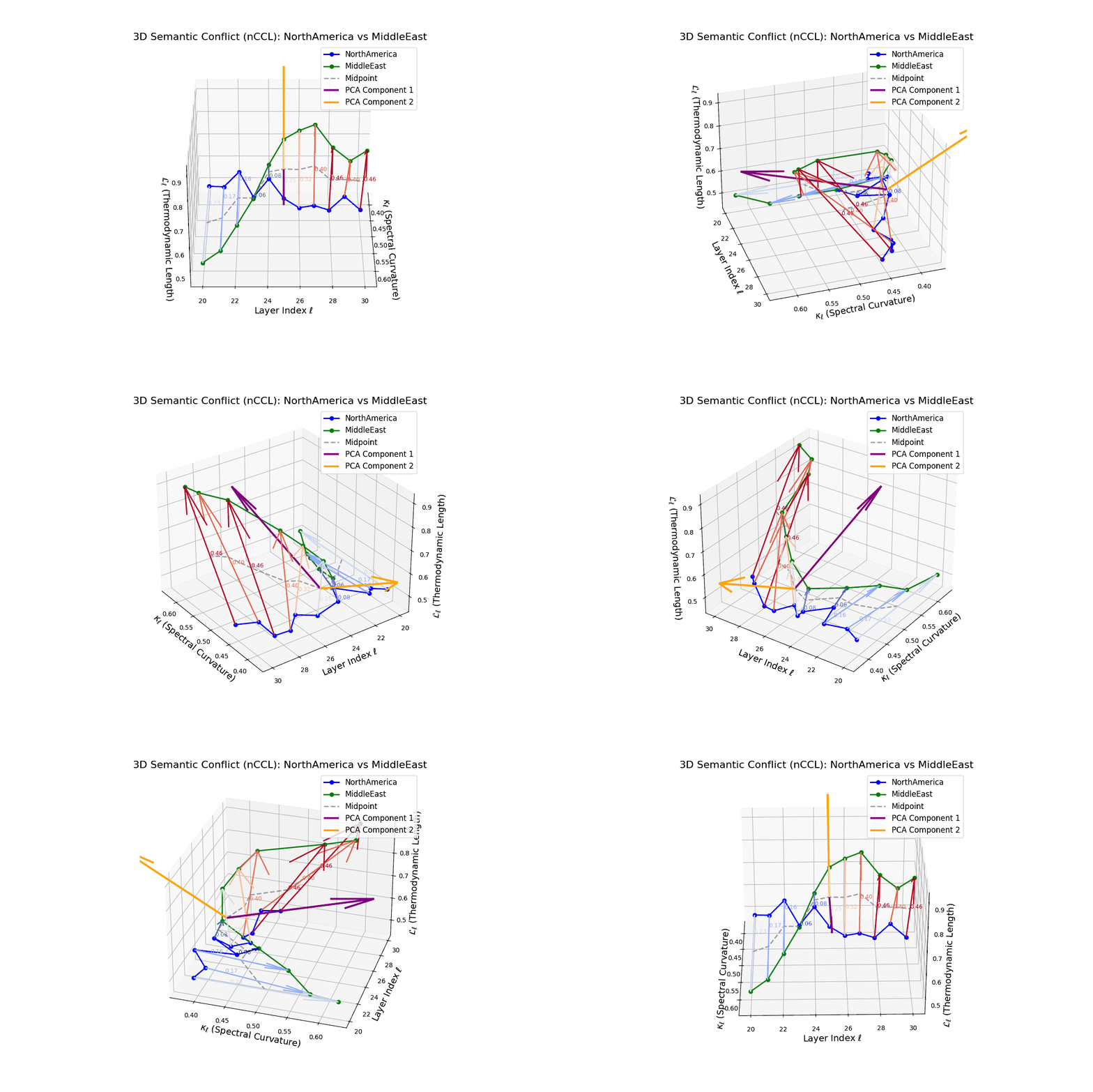
$x_\ell(\mathrm{NorthAmerica})$, $x_\ell(\mathrm{MiddleEast})$, and $x_\ell(\mathrm{Merged})$ – $\Delta_\ell = \left|x_\ell(\mathrm{Merged}) - \Phi \left(x_\ell(\mathrm{NorthAmerica}), x_\ell(\mathrm{MiddleEast})\right)\right|$. Early layers $\ell \in [20, 21]$ show minimal conflict reflecting stable inheritance. Pronounced conflict in mid layers $\ell \in [22, 28]$ signals ideological friction; late layer moderation $\ell \in [29, 30]$ suggests semantic fusion.
These layerwise semantic tensions highlight the uneven integration of cultural knowledge in large models, emphasizing the need for targeted, depth-wise alignment to mitigate bias and enhance robustness. This parallels biological epigenetic regulation, where gene expression adapts to environmental cues ([11]; [12]), and heterosis, in which genetic recombination produces traits surpassing parental baselines ([13]). Such analogies reveal fundamental geometric principles crucial for developing culturally coherent, fair, and trustworthy AI systems deployed worldwide.
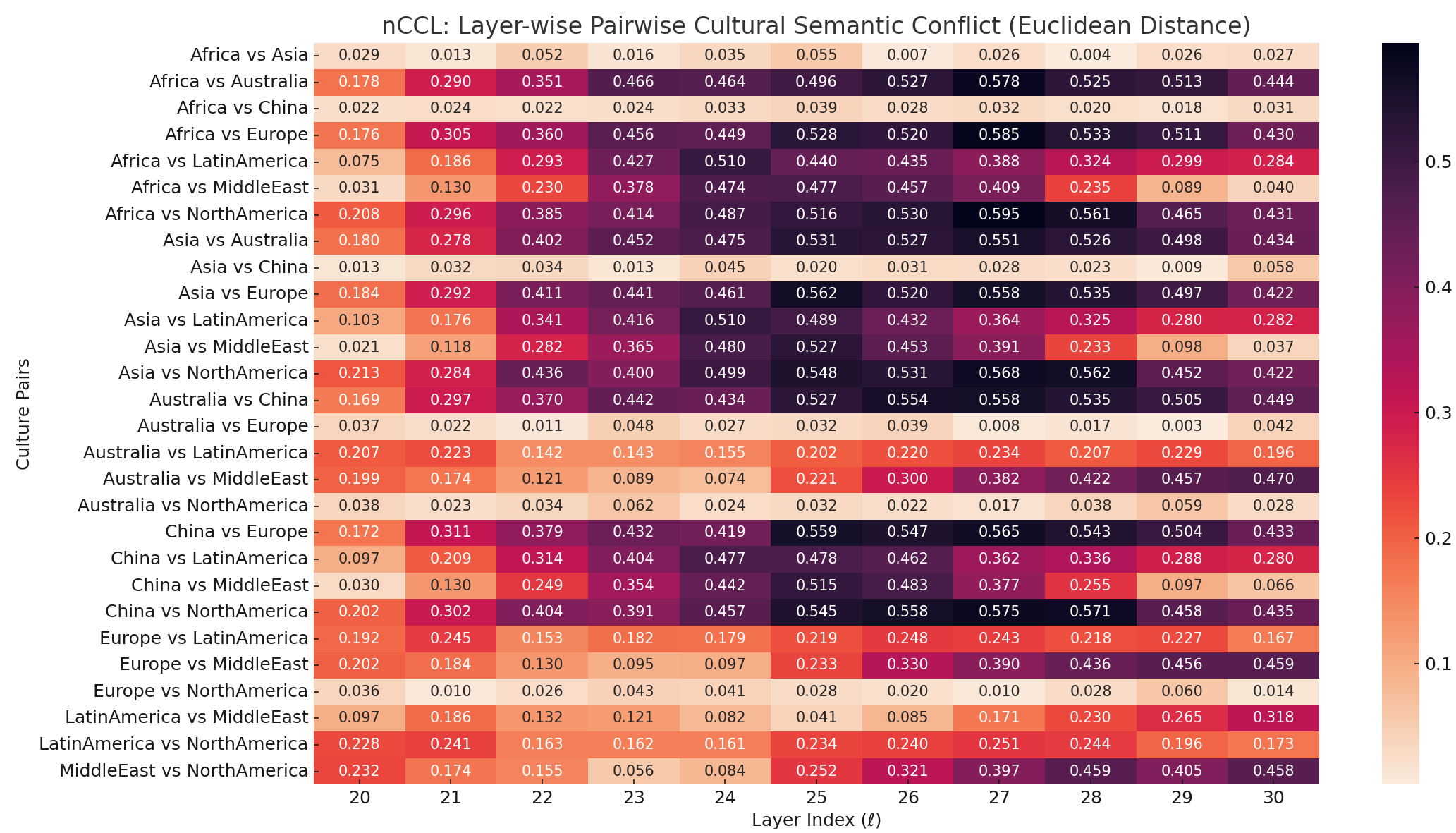
Figure below presents a consolidated visual summary of the 28 individual pairwise cultural semantic conflict analyses detailed in preceding sections. This heatmap displays the layer-wise Euclidean distances between the latent semantic vectors $(\kappa_\ell , L_\ell)$ of foundation models fine-tuned on distinct cultural corpora, across transformer layers $\ell = 20 . . . 30$. Each row corresponds to a unique culture pair, while color intensity encodes the magnitude of semantic conflict at each layer, with warmer hues signaling heightened ideological divergence.
From this comprehensive overview, several deep insights emerge. First, semantic conflict is not uniform across layers or cultural pairs–specific intermediate and deep layers recurrently exhibit peaks, underscoring their critical role as ideological tension loci within the latent geometry. Second, certain culture pairs consistently manifest greater latent semantic friction, revealing latent incompatibilities potentially arising from divergent worldviews or linguistic structures. Third, the heterogeneity of conflict patterns suggests the necessity of layer- and pair-specific alignment interventions, rather than one-size-fits-all solutions.
Collectively, this heatmap offers a macroscopic lens to pinpoint and prioritize layers and cultural dimensions that drive semantic dissonance, guiding targeted mitigation strategies. Such insights are foundational for designing culturally aware, semantically robust, and ethically aligned AI systems capable of equitable global deployment.
References
[1] Amari, Shun-ichi “Natural gradient works efficiently in learning” Neural Computation (1998).
[2] Wattenberg, Martin, Vi{'e}gas, Fernanda, and others “Using the fisher information matrix to merge neural networks” Proceedings of the 33rd International Conference on Machine Learning (2016).
[3] Weinreich, Daniel M, Watson, Richard A, and others “Sign epistasis and genetic constraint on evolutionary trajectories” Evolution (2005).
[4] Otwinowski, Jakub, McCandlish, David M, and others “Inferring the shape of global epistasis” Proceedings of the National Academy of Sciences (2014).
[5] Kauffman, Stuart A “The origins of order: Self-organization and selection in evolution” arXiv preprint (1993).
[6] de Visser, JAGM and Krug, Joachim “Topology and dynamics of the fitness landscape of RNA secondary structures” Current Opinion in Genetics & Development (2013).
[7] Landry, Christian R, Hartl, Daniel L, and others “Genetic properties influencing the evolvability of gene expression” Science (2007).
[8] Gonzalez, Anthony, Ronce, Ophélie, and others “Genetic rescue: a potential tool for conservation management” Trends in Ecology & Evolution (2014).
[9] Peyr{'e}, Gabriel and Cuturi, Marco “Computational Optimal Transport” Foundations and Trends® in Machine Learning (2019).
[10] Moyle, Leonie C and Nakazato, Takuya “Genetic incompatibilities and hybrid speciation” Trends in ecology & evolution (2011).
[11] Day, Jennifer J and Sweatt, J David “Epigenetic mechanisms in cognition” Neuron (2010).
[12] Holtmaat, Anthony and Svoboda, Karel “Experience-dependent structural synaptic plasticity in the mammalian brain” Nature Reviews Neuroscience (2009).
[13] Birchler, James A, Yao, Han, and others “Heterosis” The Plant Cell (2006).